Tredence Acquires KMK Consulting to Accelerate Healthcare and Life Sciences Growth.
Read the announcement.
Tredence Acquires KMK Consulting to Accelerate Healthcare and Life Sciences Growth.
Read the announcement.


A Quick Guide for Successful Data Migration
As enterprises respond to geopolitical unpredictability with a greater focus on security, scalability, and agility, it is natural that they are moving their critical data asset to the cloud as part of a strategic realignment. This is the core objective of data migration.
Transform Your Data Foundation with Snowflake Migration
Data, as a live repository of actions taken and targets achieved, is a competitive asset that is unique to an organization. As enterprises respond to geopolitical unpredictability with a greater focus on security, scalability, and agility, it is natural that they are moving this critical asset to the cloud as part of a strategic realignment.
To gain a competitive edge, data must reside on an advanced cloud platform that empowers business users. This is the core objective of data migration.
of organizations plan to move nonsensitive analytics data to cloud or SaaS platforms.
of organizations prioritize cost savings in their 2024 cloud initiatives.
of organizations embrace multi-cloud strategies.
What is Data Migration?
Organizations are migrating their data to the cloud in line with a larger strategic shift. They seek sophisticated technology platforms to help unify structured and unstructured data, spread it across locations and clouds, and harness it within minutes to make decisions and serve customers.
As with any shift, data migration to the cloud has its challenges. Companies across verticals face common obstacles when moving data to the cloud. For many, decades' worth of data stored in traditional, appliance-based warehouses lack the flexibility and agility an AI-led digital world demands. However, additional obstacles compound these issues. Legacy systems, often built by teams no longer in their original roles, frequently suffer from insufficient documentation detailing data flows, storage protocols, and embedded business logic. Faced with this lack of clarity, data teams grapple with
Faced with this lack of clarity, data teams grapple with:
These factors hold companies back despite clearly recognizing the advantages of moving data to the cloud.
Data engineering teams can adopt a structured, strategic approach to overcome these hurdles. Here’s what to prioritize for a smooth and impactful migration from legacy systems to modern platforms.
Start with a thorough analysis of your legacy environment. Use visualization to map out data dependencies, lineage, and traceability, identifying key objects you want to prioritize for migration. Typically, 70-75% of the data objects drive most of the value, and focusing on these ensures efficient migration.
In addition to data dependencies, visualization helps your teams understand the current scenario of workflows and code bases. This complete picture will create a clear understanding among stakeholders of the strengths and downsides of the existing data landscape, streamlining their decision-making for an optimized migration strategy.
This initial analysis also needs to estimate the migration exercise's ROI, accounting for further downstream variables.
For example, legacy and modern environments usually run parallel during the final handover. Depending on the complexity of your systems, this overlap may last several weeks to months to ensure any gaps are addressed before fully decommissioning the old systems. This parallel approach minimizes risks and avoids disruptions. It is important to estimate this overlap period with reasonable accuracy. Migrating from legacy platforms to cloud platforms will mean ending expensive contracts for the former. Even a few weeks could be the difference between renewing or cancelling a years-long contract with your legacy provider.
Other variables include faster compute times, easier scaling, and training and maintenance costs. Approximating these accurately at the outset wins buy-in across the organization for the exercise.
With a time-bound, clearly defined strategy for cloud data migration, you are ready for the migration journey that typically extends from six months to a year. It comprises three steps.
You have already identified which data objects to retain and the target cloud Data Lake House for migration. To ensure continuity, historical data must be carefully transferred into the cloud warehouse, while incremental data entering legacy systems should be synchronized with minimum lag. Cloud Data Lake House platform enables scaling of both structured and unstructured data into unified architecture that delivers last mile business insights using AI and BI workload for various personas in the organization.
Why is this important?
Users need to see the value quickly—whether through real-time insights or seamless access to updated datasets.
Use streaming, micro-batching, or scheduled loads to ingest incremental data into the cloud. Tailor your approach to historical and incremental data migrating, avoiding a one-size-fits-all approach.
Example: Data Migration Approach in Travel & Hospitality
| BATCH | STREAMING | API |
|---|---|---|
|
ERP systems Property management systems CRM systems Customer feedback & review platform and POS systems |
Booking & reservation engine Clickstream data Social media feeds Digital marketing data |
3rd-party online travel agencies (OTAs) Weather data |
When you are sure you have a representative picture of the final system, share previews with users. This will accustom them to the upcoming change, paving the way for easier adoption.
This step tends to be the most complex of your data migration. It involves modernizing your existing processes and business logic, often embedded in your legacy technology stack. These include refurbishing code bases and activities carried out by legacy ETL (Extract, Transform, Load) and reporting tools. The objective is to adapt these processes to function efficiently and as expected in the new cloud environment.
Originally designed for the legacy environment where the infrastructure was already paid for, the run time of these processes did not impact costs significantly. However, this must be now optimized for the cloud where you are charged for compute power and time. This may involve a shift to cloud-friendly data extraction tools like Fivetran, OpenFlow (Snowflake new data integration tool in private preview) and DBT for data transformation.
For reporting, you may continue with the existing tools or move to new reporting tools for optimization on the cloud. In either instance, the generated reports may not be of the desired format and frequency due to hidden causes during the migration or in the new environment. It is imperative to identify these deviations and fix them.
Therefore, process migration is a highly intricate step with multiple layers of complexity that require detailed design, execution, and often, automation to ensure everything performs well in the cloud environment.
It can be broken down into:
While you will have your strategy roadmap to refer to, you can expect to make adaptations in live situations - a factor of relevance right until the handover and even beyond.
This is the last, but the most critical step of your migration journey. Now that you have migrated the data and related processes to the cloud, you must hand the system over to your business users. While doing this, you must attend to validation. This involves verifying that the reports and data are correct in the cloud.
Accuracy would have been monitored throughout the migration, but the final lap with all the objects and reports is the most crucial. Here is one example of why validation is key. In your legacy environment, you might have been processing data on a nightly basis, so the data would typically be one day behind your ERP systems. But with the modernization, you could now be pulling data much faster, possibly in real time or several times a day. When comparing the new data and reports in your cloud environment to the legacy data, you may notice discrepancies. These discrepancies could be due to the different data refresh frequencies. But how does one explain this convincingly to the business users?
The answer is streamlining the validation process with automation. You can use AI-based or rule-based algorithms to compare between legacy and new environments. You can assess the data and reports at various levels: table by table, row by row, and column by column. MD5 hash mechanism can be employed to validate whether the elements match. Any mismatches will be reported in standardized ways, with explanations — such as differences in data refresh frequency or optimizations made in the new environment that result in more accurate metrics. If the mismatch is due to genuine defects in the new system, such as errors in the code, this must be speedily resolved, and the data reprocessed.
If, after all the migration work, you cannot convince your business users that the new cloud system is accurate and reliable, they will not adopt it putting your entire investment at risk. Hence, data validation is as much about change management as it is about validation, making it the most vital step in the success of your migration.

| Phase | Key Activities |
|---|---|
| Analysis and Discovery | Identify and map data objects, dependencies, and usage through a visual overview. Create a migration plan and establish ROI by estimating time frames for the migration and operational costs for the cloud warehouse, and consequent savings. |
| Migration Process |
|
| Change Management | Run legacy and new systems in parallel for a few weeks or months, train users in regular and exception handling, and ensure smooth adoption before decommissioning the legacy system. |
An area of considerable deliberation in your data migration strategy is deciding which cloud warehouse platform is right for your organization. You need a platform that will best support your data and analytics needs, scale apace with your growth, and streamline spends.
Here are a couple of factors to consider in addition to those mentioned above:
A detailed comparison of major cloud data warehouse platforms, enumerating their features, market positioning, and technical capabilities.
| Feature | Snowflake | Combining data lake and warehouse capabilities | Major cloud provider's data warehouse | Alternative cloud data warehouse provider | Traditional enterprise software leader's cloud data offering |
|---|---|---|---|---|---|
| Architecture | Flexible multi-cluster design with separate compute and storage | Multi-cluster shared data architecture | Distributed system with no shared components | Fully managed, serverless design optimized for big data | Integrates analytics and storage in a single system |
| Scaling | Instant, automatic | Automatic, elastic | Manual, minutes | Automatic | Automatic |
| Storage/Compute | Fully separated | Fully separated | Partially separated | Fully separated | Fully separated |
| Pricing Model | Per-second, storage + compute | Credit-based consumption | Instance-based + storage | Pay-per-query | DTU/vCore + storage |
| Cross-cloud Support | Cloud Agnostic for major CSPs | Cloud Agnostic for major CSPs | Cloud Native | Cloud Native | Cloud Native |
| Concurrent Users | Unlimited (with scaling) | Limited by cluster size | Limited by cluster | Unlimited | Limited by resources |
| Data Sharing | Native, secure | Native Secure Data Sharing | Limited | Limited | Limited |
| Maintenance | Zero-management | Some management | Some management required | Zero-management | Some management required |
| AI/ML Integration | Native integrations with Snowpark for Python, Java, and ML frameworks | Supports AI/ML with external integrations | Limited AI/ML integration | AI/ML optimized for search & queries | AI/ML integration via third-party |
Snowflake offers a powerful platform to unlock the full potential of your data. Founded in 2012 by Benoit Dageville and Thierry Cruanes (Oracle architects with a foundational knowledge of databases) and Marcin Żukowski (a query optimization and data processing expert), the platform pioneered embracing cloud-native architecture for data warehousing. Large enterprises like Capital One, JPMorgan Chase, and Office Depot have adopted it to reduce their data infrastructure costs and complexity.
It consists of three key layers that help build this valuable data foundation that drives business value.
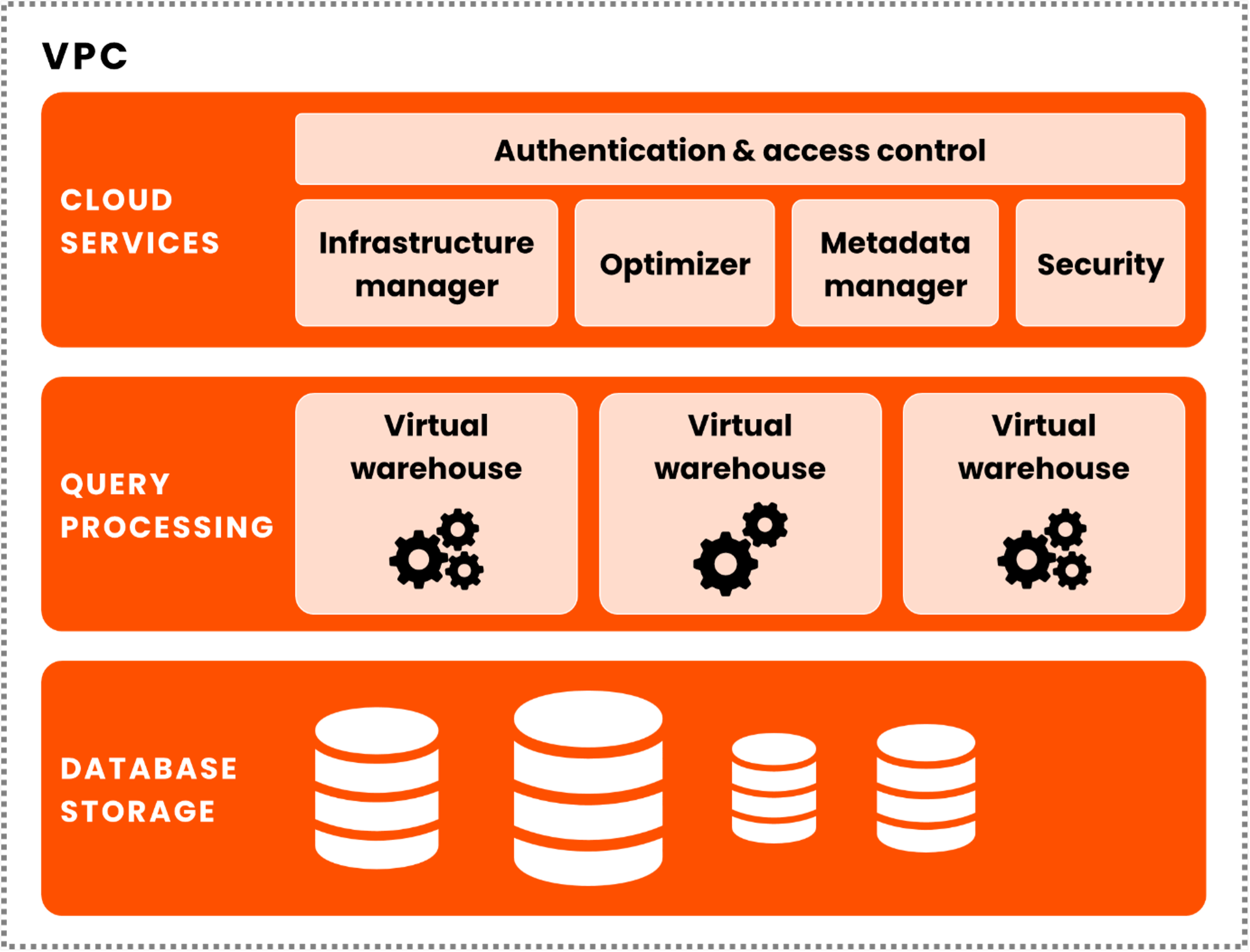
Database Storage
When data is loaded into Snowflake, it is reorganized into an optimized, compressed, columnar format. Snowflake stores this data in cloud storage and manages all aspects of how this data is stored. Snowflake now supports Iceberg open file format as an alternative to snowflake native file format. This allows interoperability of leveraging the data available in cloud service provider storage layer to process using Snowflake compute with any vendor lock-in concerns.
Query Processing
Query execution is performed in the processing layer. Snowflake processes queries using “virtual warehouses”. Each virtual warehouse is an independent compute cluster that does not share compute resources with other virtual warehouses. As a result, each virtual warehouse has no impact on the performance of other virtual warehouses.
Cloud Services
The cloud services layer is a collection of services coordinating activities across Snowflake. These services tie together all of the different components of Snowflake to process user requests, from login to query dispatch. The cloud services layer also runs on compute instances provisioned by Snowflake from the cloud provider.
Source: Snowflake Documentation
Snowflake migration helps unify diverse data and empowers business users to create tailored virtual warehouses and share data confidently with partners. It enables pay-as-you-go usage and easy scaling of analytics without new resources, unlocking the full potential of data without compromising on cost efficiency.
1. Support for Multiple Data Types
In legacy systems, you are often limited to processing and analyzing structured data, such as transactional data or product information. However, Snowflake allows you to ingest and process not only structured data but also semi-structured and unstructured data. This capability expands your ability to analyze various data formats, such as JSON, XML, and even unstructured documents like PDFs, exponentially enriching your insights.
2. AI/ML Capabilities
Legacy environments are often not built to run predictive or prescriptive algorithms, limiting their capacity for advanced analytics. Snowflake, however, integrates AI and machine learning capabilities, enabling you to apply advanced algorithms directly to your data, unlocking sophisticated scenarios and predictions.
“We also help get grounded, cited answers, so that they know where the answers are coming from. Our value prop at Snowflake is to create a single unified product, where …AI is tightly integrated.”
- Sridhar Ramaswamy, CEO, Snowflake
Source: Times of India
3. Scalable Infrastructure
One of the significant pain points in legacy environments is the inability to scale the infrastructure continuously. When performance issues arise or more data is added, it requires extensive capacity planning and infrastructure upgrades. Snowflake eliminates this problem, as it is designed for automatic and seamless scaling. Storage and compute are separated, and Snowflake offers the flexibility to adjust each of these independently based on your needs, so you can optimize performance on the fly without worrying about underlying infrastructure management.
4. Pay-As-You-Go Pricing
Snowflake operates on a consumption-based pricing model, meaning you pay only for the storage and compute you use, with billing down to the second. This is a significant advantage over traditional systems, where you might be locked into high upfront costs for infrastructure or ongoing maintenance fees. For instance, with Snowflake, if you stop processing after a minute and 10 seconds, you are only charged for that time, providing you with substantial cost savings.
5. Automatic Data Recovery
In legacy systems, recovering accidentally deleted data can be lengthy challenging, and sometimes unsuccessful. With Snowflake, you can take advantage of its native
capabilities. If data is accidentally deleted or corrupted, you can restore it instantly, minimizing downtime and ensuring data and analytics integrity.
6. Data Resiliency
Snowflake provides robust data resiliency features to ensure business continuity. For example, if your Snowflake environment is hosted in an AWS region (e.g., US East) and that region experiences an outage, Snowflake allows you to replicate your data to another AWS region or even another cloud provider, such as Azure or GCP. This ensures that your systems remain up and running, no matter what.
7. Simplified Data Sharing
One of Snowflake’s standout features is its data-sharing capability. Once your data is stored in Snowflake, you can easily share it internally with different business units or externally with partners, suppliers, or other stakeholders. The sharing process is straightforward, requiring just a few clicks, and Snowflake ensures proper permissions and data masking, so you don't have to worry about exporting data manually or using external file transfers for privacy reasons.
8. Built-in Security and Governance
So, your data stays secure as it is queried and shared; Snowflake brings together powerful security controls — which provide identity and access management across CSPs, networking, and encryption — with a unified governance model that enforces policies, tags, and lineage.
Source: Snowflake for Analytics | AI Data Cloud
9. No Infrastructure Management
Snowflake takes care of all infrastructure management. Hence, training and deploying a large team to maintain and upgrade your systems is not required. Unlike legacy environments, where you may have had to manage hardware, apply patches, or scale infrastructure manually, Snowflake automates these processes. This means you can focus on your core business and strategic initiatives, leaving the technical complexity to Snowflake and your implementation partner.
“Snowflake brings data gravity, resilience, and streamlining to data management and analytics using its unified data and AI cloud, converting your organizational data into a winning asset for market leadership to deliver measurable business impact.”
- Devang Pandya, Vice President, Data Engineering, Tredence Inc.
The availability of up-to-date, accurate, and diverse data on a single platform powers insights-backed decision-making.
Given the plethora of competencies required—technology strategy, domain knowledge, implementation experience, and change management support—it is not unusual for an internal cross-functional team to look for a seasoned partner for their data migration.
Typically, a partner with an established track record will:
Source: Migrate to Modernize Your Data and Analytics
Tredence uses its expertise in cloud and data engineering to build services and accelerators created on native cloud components. Our data modernization services and accelerators assist clients with big data modernization and data migration to respective cloud platforms in a short period of time. Our solutions also help unlock greater value from the same data; automation tools and platform operations enable higher ROI and value realization up to the last mile while lowering your cost of implementation.
Source: Data Migration and Modernization Services | Tredence
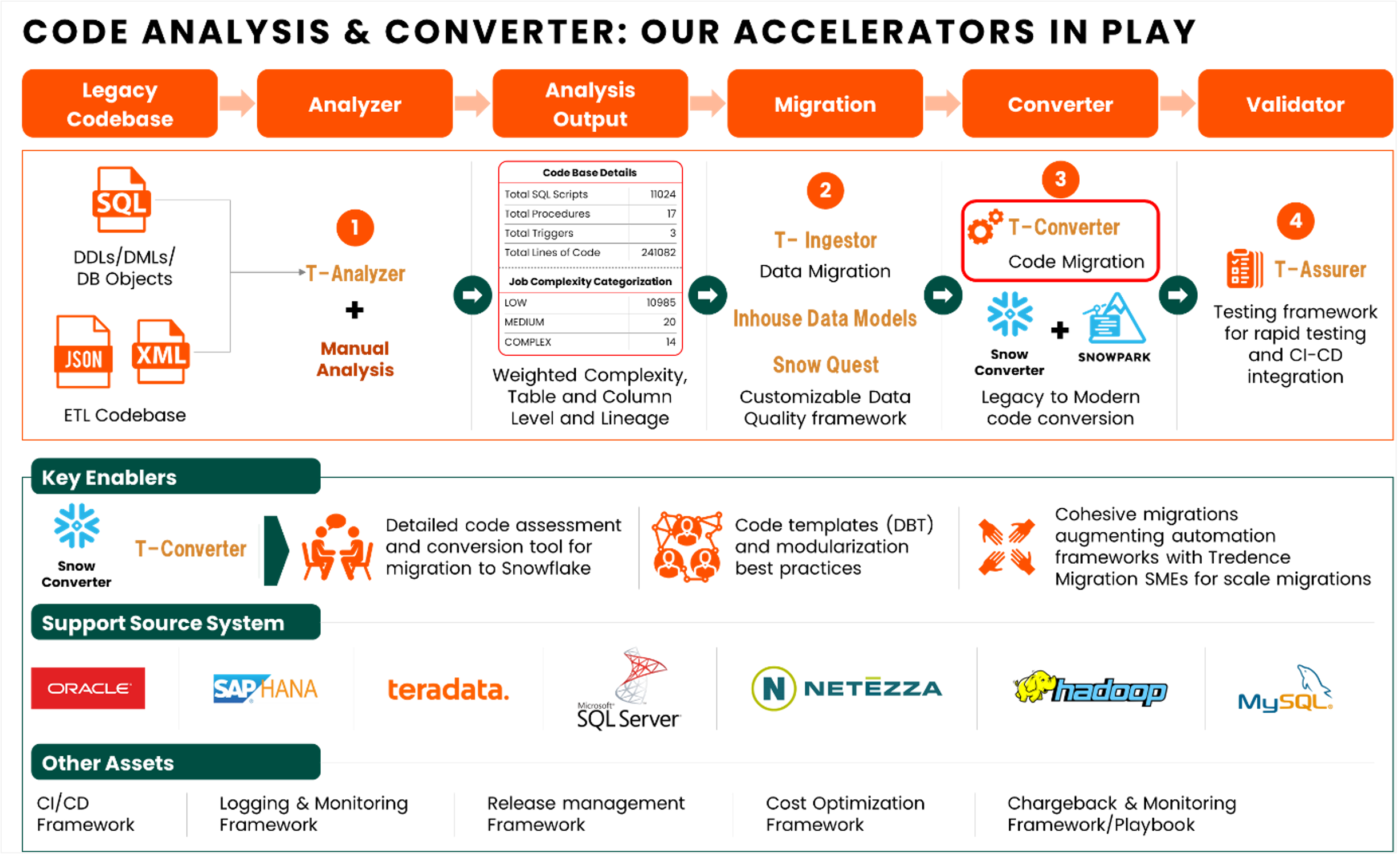
At Tredence, we bring expertise and proven results to every step of your data migration journey.
A Global CPG Giant
Challenge: The client’s legacy codebase for supply chain initiatives was sub-optimally designed, leading to a sprawling and inefficient environment with frequent downtimes and requiring frequent system refreshes.
Solution: Leveraging Snowflake capabilities, Amazon EMR, Tableau, and Tredence accelerators in the AWS environment, Tredence modernized the supply chain system.
Impact:
A Global Leader in Hygiene Products
Challenge: The client relied on an on-premises Hadoop-based system built on Cloudera, which constrained their ability to scale efficiently. Reporting SLAs were frequently missed, and the system incurred escalating operational costs.
Solution: Tredence used its accelerators to migrate the client’s data ecosystem to Snowflake on Google Cloud, and Looker for BI.
Impact:
Here is a detailed look at some Tredence accelerators. These are boutique tools that have successfully streamlined many enterprise data migrations:
T-Discoverer
A database and ETL code reverse-engineering accelerator for analysis and discovery. It deconstructs legacy tech stacks, workflows, codebases, and interdependencies into visualizations, enabling deeper insights and optimized migration strategies.
T-Ingestor
A codeless, automated data migration accelerator with built-in quality, catalog, and metadata management features. Combined with other Tredence accelerators and external tools, it ensures systematic migration with minimal downtime, increased safety and compliance. These in-house accelerators, some of which are platform agnostic, have been shown to shorten the migration journey from data warehouses (Teradata, Netezza, Exadata, etc.) and data lakes (Hadoop, Cloudera, Hortonworks to Snowflake by more than 30%.
T-Converter
Handles code conversion during the Convert and Build phase of the key process migration stage. It accelerates code conversion for relational databases (SAP BW, HANA, etc.) by directly converting ~20-30% of the code on average while re-designing/re-engineering helps retire a lot of unused codebases.
T-Assurer
A testing framework created by Tredence for rapid testing and CI-CD integration. It tests data under extreme conditions and validates results so that the least expected inconsistency can be explained or fixed well before going live.
Use Tredence's data migration and modernization services to accelerate your cloud migration. We assist you in developing connected intelligence, providing teams with reliable insights, and enabling Snowflake's predictive and GenAI use cases. With +250 Snowflake-certified architects and +10 approved accelerators, we are an Elite Snowflake partner that offers scalable data platforms, AI/ML solutions, and seamless migrations that have a quantifiable impact on various industries.
Utilize the Snowflake AI Data Cloud to innovate further; collaborate with Tredence to update your data foundation and transform your data into a competitive advantage.
Unify and monetize your data with Tredence and Snowflake.