Agentic AI pursues goals autonomously across your enterprise data stack, executing multi-step workflows that previously required continuous human direction. This guide covers what your organization needs to understand before deploying agents at scale.
What agentic AI is and how it differs from generative AI and RPA
The four components of an AI agent and how they work together
Agentic AI use cases across healthcare, manufacturing, financial services, and supply chain
How to build and govern an agent deployment from PoC to production
The KPIs, evaluation metrics, and security controls that matter at enterprise scale
What is Agentic AI?
Agentic AI definition:Agentic AI is a class of AI system that combines a large language model with memory, planning, and access to external tools, allowing it to pursue complex, multi-step goals autonomously rather than respond to a single prompt.
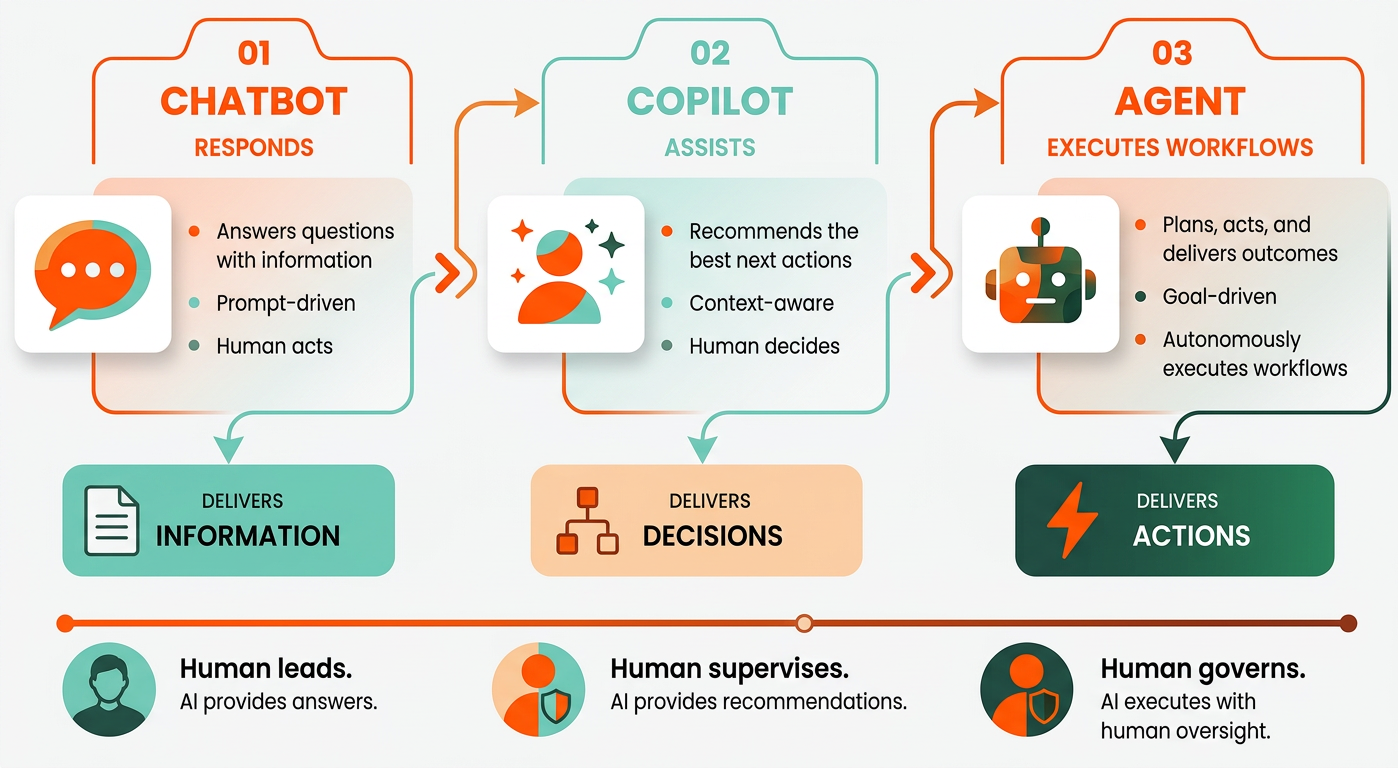
The most common misconception about agentic AI is that it amounts to a smarter chatbot, when in fact the underlying architecture is meaningfully different. Where a chatbot waits for a question and returns an answer, an agentic system receives a goal and figures out for itself how to reach it, calling whatever tools and data it needs along the way and adapting when steps return results it did not expect.
That distinction matters because it changes the unit of value your organization gets from AI. A chatbot accelerates a single human task. An agent owns the workflow.
In simple terms: Agentic AI is AI that works on your behalf, setting its own sub-goals, choosing its own tools, and adapting its approach until a task is done.
Chatbots answer, copilots recommend, agents execute — and the human role shifts from leading to governing.
The underlying mechanism here is the perception-action loop: the agent reads the current state of its environment (its goal, memory, and outputs of any tools it has called), decides what to do next, takes that action, observes the result, and continues looping until either the goal is reached or it escalates to a human. Each loop is informed by what came before it, which is how agents stay coherent across long-running tasks where chatbots and copilots would have to be reprompted at every step.
For enterprise leaders, the more pressing question is what your organization looks like when agents own meaningful portions of the operating model.Are you building toward that state deliberately or stumbling into it after competitors have already moved?
The Evolution from Scripts to Autonomous Systems
Enterprise AI automation has progressed through five distinct phases, and understanding agentic AI vs. traditional AI approaches makes clear why each generation was insufficient on its own. What started as rule-based scripts in the early 2000s has evolved to today's agentic systems, which are capable of planning workflows and acting across enterprise infrastructure without continuous human direction.
The fastest way to understand what makes agentic AI architecturally different is to look at what came before it. Each phase of enterprise automation solved a real problem and then ran into a limitation that the next generation was built to address.
How Enterprise Automation Got Here
pre-2015
Rule-Based Automation
Follow the rules
Automated repetitive tasks using predefined if–then logic.
Understood and generated natural language, but humans still had to decide and act.
2024–present
Agentic AI
Understand → Decide → Act → Learn
Reasons, uses and takes multi-step action toward a goal.
Agentic AI vs. RPA: Closest Neighbor in the Stack
RPA is the closest neighbor to agentic AI in most enterprise automation stacks, and the comparison comes up in nearly every evaluation conversation we have with data and engineering leaders. The two technologies are best understood as solving different problems, with meaningful overlap in the workflows where they coexist.
Where RPA delivers agentic AI process automation for fixed workflows, agentic systems extend that automation to cover dynamic, judgment-dependent tasks.
Answer the questions to trace your path
Is the workflow well-defined, rule-based and repeatable?
Yes
Are the inputs structured and predictable?
Yes
Use RPA
Rule-driven
Predictable inputs
High-volume tasks
Follows defined steps
No
Use Agentic AI
Handles unstructured or varied inputs
Adapts to changes
Manages exceptions
No
Does the work require judgment, reasoning or handling exceptions?
Yes
Use Agentic AI
Reasoning and judgment
Handles exceptions
Learns and improves over time
No
Does it span multiple steps, systems, or require adaptation?
Yes
Use Agentic AI
Orchestrates multi-step workflows
Adapts and re-plans
Goal-driven execution
No
Use RPA
Simple, single-step tasks
Stable environments
High efficiency
Bottom Line
RPA and Agentic AI are complementary, not competing.
Use RPA when…
The process is fixed, high-volume, and the inputs never vary.
Use Agentic AI when…
The work needs judgment, handles exceptions, or spans many steps.
Each transition in this sequence solved a problem the previous generation could not handle. What makes the current shift different is that the automation layer itself can now carry the reasoning, which is why the conversations about agents look so different from the conversations about RPA or generative AI in isolation.
Still unsure?
Many enterprises combine RPA and Agentic AI to automate end-to-end processes at scale. Understand the best fit for your enterprise.
Agentic AI vs. Generative AI
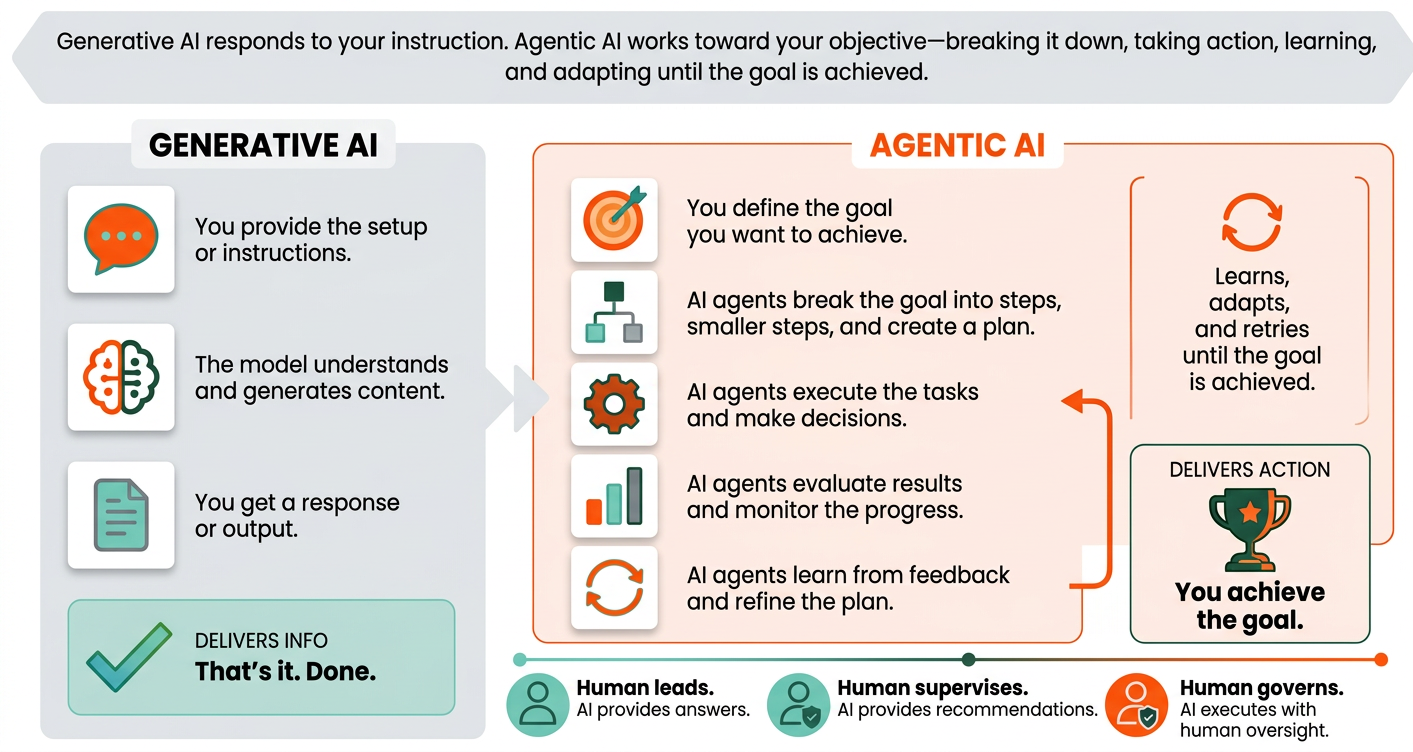
Generative AI produces content like text, images, or code in response to a prompt. Agentic AI uses that same generative capability as its reasoning core and layers on memory, planning, and tool execution to complete multi-step goals without requiring human guidance at each step.
Two Technologies Working Together
Generative AI is a capability, and Agentic AI is a system built around that capability. An agent uses generative AI for its reasoning, then surrounds that reasoning with the operational components autonomy requires: persistent memory, a planning mechanism, and access to the tools the agent needs to take action in the world.
Consider what happens when you ask each system to handle a market analysis. Ask a generative AI model to write one, and it writes it from whatever you've put in the prompt. Give an agentic system the goal of producing a weekly competitive market analysis and sending it to the VP of Strategy every Monday, and it queries your data sources, identifies the relevant signals, drafts the analysis, formats it, and sends it. The next Monday it does the work again, this time accounting for what changed since the last run.
The question of generative AI vs. agentic AI ultimately comes down to scope: generative AI handles a moment; agentic AI owns a mission.
A Side-by-Side Comparison
Generative AI completes a turn. Agentic AI keeps working until the goal is met.
Risk profile matters most for enterprise governance, and it explains why agent deployment requires different controls than generative AI deployment. A hallucinating chatbot produces a bad answer that a human reviewer can catch before anything actually happens. A hallucinating agent can take action on that bad reasoning before anyone reviews it, sending the wrong email, writing to the wrong record, or calling the wrong API. The governance and observability work covered later in this guide exists to close that gap.
Anatomy of an AI Agent: How Does Agentic AI Work?
Agentic AI works through a perception-action loop: the agent reads its goal and current environment state, decides on a next action, executes that action through a tool or API call, observes the result, and loops until the goal is complete. Four components make this possible:
→→→
Reasoning (LLM Core)
The large language model handles the reasoning work: interpreting the current state of the agent's task, deciding what to do next, and producing either a response to the human or a tool call to the broader system. Modern deployments increasingly use reasoning models specifically optimized for multi-step thinking, which tend to outperform general-purpose models on the kind of sustained, sequenced decision-making that agent workflows demand.
Memory (Short-term and Long-term)
Short-term (Context Window): The context window holds everything the agent knows about its current task, including its goal, recent tool outputs, and the conversation history so far. Context is finite and managing it well is one of the largest determinants of whether an agent stays cost-efficient at production volume.
Long-term (Vector Storage): Long-term memory typically lives in a vector database the agent can query, and it holds the enterprise knowledge the agent needs to reason against, including product catalogs, past decisions, customer histories, and policy documents. If this data layer is incomplete or stale, the agent reasons against bad information and produces confidently wrong outputs at scale.
Long-term memory quality is entirely dependent on data infrastructure quality. Most agentic AI pilots that fail in production fail because the data layer underneath them was never built to support agentic reads in the first place.
Planning, agentic AI design patterns, and goal decomposition
Planning is how the agent decomposes a goal into executable steps. Three patterns dominate in production deployments.
Chain-of-Thought (CoT) prompts the model to reason through a problem step by step before acting, which improves reasoning quality on complex tasks.
ReAct (Reason + Act) alternates between reasoning about the situation and taking an action, and is the standard pattern for most production agents because it keeps the model's reasoning grounded in real tool outputs rather than internal speculation.
Tree-of-Thought lets the model explore several possible action paths in parallel and select the most promising one, which adds cost but is justified for higher-stakes decisions where the wrong path is expensive to reverse.
API calls into enterprise systems, both read and write
Web search for live external information
Code execution in a sandboxed environment
File creation and editing
Database queries
The ability to spawn additional agents to handle sub-tasks
The breadth and specificity of an agent's tool access is one of the most consequential design decisions in any deployment, because it defines what the agent is physically capable of doing in the world. Tool access is also where the security model lives, which is covered in The Agentic AI Stack.
Model Context Protocol (MCP): The De Facto Standard for Agent Tool Connectivity
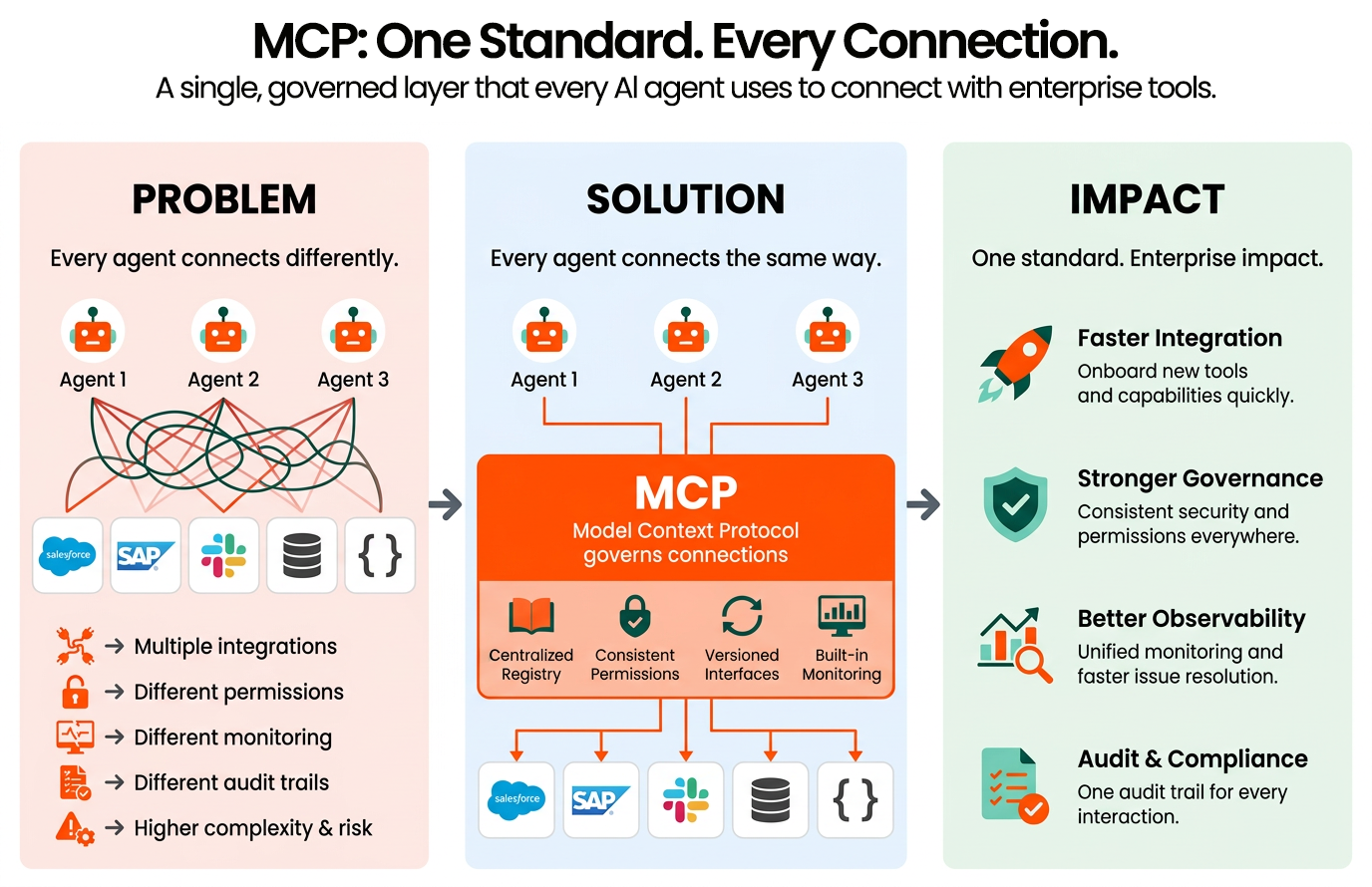
Model Context Protocol (MCP) has moved from emerging standard to the default infrastructure layer for enterprise agent deployments. In the same way TCP/IP became the universal protocol for network communication, MCP has become the universal interface through which agents connect to tools, data sources, and external systems.
One governed layer between every agent and every enterprise tool.
Five practices for enterprise MCP governance:
Practice 1 of 5
Maintain a centralized MCP server registry
Every tool your agents can call should be catalogued, versioned, and documented in one place. Ad-hoc tool connections outside this registry are a security and auditability liability.
Practice 2 of 5
Enforce least-privilege tool access at the MCP layer
Each agent should be granted access only to the MCP servers it needs for its designated workflow. Tool access permissions should be reviewed and reauthorized on the same cadence as data access permissions.
Practice 3 of 5
Version and test MCP server interfaces
An MCP server update that changes the shape of a tool response will silently break the agent workflows that depend on it. MCP server interfaces should be treated like production APIs, with versioning, regression testing, and change management applied.
Practice 4 of 5
Monitor tool call volume and latency at the MCP layer
Excessive or looping tool calls are often the first observable signal that an agent is malfunctioning. Instrumentation at this layer catches the problem before it becomes a cost overrun or a correctness incident.
Practice 5 of 5
Audit tool call history for compliance
In regulated industries, every tool call an agent makes is potentially a compliance record, including what was accessed, when, and with what parameters. The MCP layer is where that audit trail gets generated.
Agentic AI vs. What You Already Have: An Honest Enterprise Comparison
Before investing in agentic AI, understand how it fits with the automation stack and AI technologies you already have, and where each approach works best. Most enterprises already have a mix of RPA, chatbots, copilots, and traditional automation. The question isn't which technology wins; it is which approach fits the workflow. The right approach depends on how much autonomy the workflow requires, from predefined execution to human assistance to dynamic, goal-driven action.
Predefined executionDynamic, goal-driven action
What it does
RPA Bots
AI Chatbots
GenAI Copilots
Agentic AI
Operates from fixed rules
✓
—
—
Limited
Understands natural language
—
✓
✓
✓
Determines next action
—Predefined
—Responds only
LimitedRecommends
✓Reasons and decides
Executes multi-step workflows
✓Predefined
—
Limited
✓Dynamic
Handles workflow exceptions
Limited
—
Limited
✓
Works with existing automation
✓Native
Limited
✓
✓Orchestrated
Best for
Repetitive, structured tasks
Q&A and support
Human-led knowledge work
Goal-driven, end-to-end workflows
The goal isn't to replace every existing automation with an agent. Agentic AI can orchestrate the systems already in place, including RPA, APIs, applications, and humans, while adding reasoning and decision-making across the workflow.
When the focus is only on the “right tool for the right task,” enterprises can end up with a fragmented automation stack: RPA handles invoicing in one part of the business, a copilot supports analysts elsewhere, and an agent answers procurement questions somewhere else. The bigger opportunity is to connect these capabilities through a common operating model.
The Agentic Tech Stack
The enterprise agentic AI stack has five layers: foundation models, orchestration frameworks, memory and data, tool integrations, and governance. The component choices at each layer determine whether your deployment ships in 90 days or stretches across 18 months.
The stack itself follows a layered architecture, with each layer providing capabilities the layer above it depends on. The component choices you make at each layer compound, so decisions made at the bottom of the stack tend to determine what's possible at the top.
The Five Layers
Select a layer to open it. Layer 01 is the foundation, layer 05 the apex.
Key insight
Organizations often overinvest in framework selection and underinvest in the two layers that determine production readiness.
Data foundation – the contracts that govern what the agent can see, trust, and act on.
Observability – the visibility needed to detect drift, evaluate decisions, and understand what happened before the incident.
A sophisticated orchestration framework running on unreliable data and invisible to the operations team is still a pilot that never reaches production. Every agentic AI workflow, from a single-agent PoC to a production multi-agent network, runs on decisions made at these five layers.
Agent Harness: Structuring How Agents Run in Production
An agent harness is the execution wrapper that sits around an agent's core logic, managing the run lifecycle, injecting context, enforcing constraints, handling errors, and routing outputs. It is the layer that determines whether an agent works only in a notebook or runs reliably in production.
Building an agent in a framework like LangGraph or CrewAI gives you the reasoning and tool-calling logic. The harness is everything that surrounds that logic, including how the agent is invoked, what context it receives at startup, how long it is allowed to run, what happens when an error occurs, and how its outputs are routed to downstream systems or human reviewers.
Core components of an enterprise agent harness:
Run initialization and context injection. The harness assembles the agent's initial context at startup, which includes loading the goal, injecting relevant memory from the vector store, applying the system prompt, and passing in the correct tool permissions for this specific run. This is where role-based context scoping happens: an agent run initiated by a procurement analyst should receive different context and tool permissions than the same agent run initiated by a CFO.
Execution lifecycle management. The harness controls the run boundary. It sets the maximum number of reasoning steps, enforces wall-clock time limits, handles tool-call timeouts gracefully, and triggers circuit breakers that terminate a run when anomalous behavior is detected, such as infinite looping, excessive tool calls, or cost overruns.
Error handling and retry logic. Production agents encounter tool failures, API timeouts, and unexpected outputs as a routine matter. The harness defines how the agent responds in each case, whether it retries, escalates to a human reviewer, falls back to a simpler tool, or terminates with a structured error report. Leaving this behavior to the agent's own judgment is itself a governance gap.
Output routing and handoff. The harness determines what happens after the agent completes a run, whether that means writing outputs to a data store, triggering downstream systems, formatting results for human review, or escalating exceptions for follow-up. This is the integration point between the agent layer and the rest of the enterprise data stack.
Human-in-the-loop checkpoints. For workflows with defined approval thresholds, the harness manages the pause-and-resume lifecycle, suspending the run, routing the pending decision to a human reviewer, waiting for approval, and resuming execution with the approved action recorded in the audit log.
Key insightThe agent harness is one of the least-discussed and most underbuilt components in enterprise agent deployments. Teams that skip it tend to ship agents that work in demos and fail in operations. Treat the harness as the layer where the organization's operating model gets encoded into agent behavior, expressed as production-grade execution infrastructure rather than as configuration settings sprinkled across notebooks.
Agentic AI Testing and Evaluation: Measuring What Actually Matters
Evaluating agentic AI systems is fundamentally different from evaluating standard LLM outputs. The quality of individual responses is only one dimension; agents must also be evaluated on task completion, tool use correctness, trajectory efficiency, and behavioral consistency across thousands of runs.
Evaluating a chatbot means asking whether the response was accurate and helpful. Evaluating an agent means asking whether the agent completed the goal, whether it used the right tools in the right sequence, whether it made any unintended writes, and whether it would behave the same way on the same input tomorrow. These are measurement problems that require a different evaluation infrastructure entirely.
Four evaluation dimensions for enterprise agents:
Task-level outcome evaluation
Did the agent complete the assigned goal?
Outcome evaluation scores the end state of the world after an agent run, examining whether the intended result was achieved rather than scoring the quality of individual steps. For each workflow type, define a ground-truth outcome and score every agent run against it. The target for production agents on designated workflows is a Task Completion Rate (TCR) above 90%.
Trajectory evaluation
Did the agent take a reasonable path to reach the outcome?
An agent that arrives at the correct answer by making 40 tool calls when 6 would have been sufficient is expensive and fragile, even if the outcome score looks fine. Trajectory evaluation examines the sequence of reasoning steps and tool calls, flags unnecessary detours, identifies looping patterns, and measures step efficiency. This is the layer that surfaces architectural problems that outcome evaluation alone will miss.
Tool call correctness evaluation
Did the agent call the right tools with the right parameters?
For each tool call made during a run, evaluate whether the tool selection was appropriate, whether the parameters were correctly formatted, whether the agent correctly interpreted the tool's output, and whether any write operations were authorized for this agent. This requires a curated test suite of agent runs with labeled correct tool sequences, functioning as the equivalent of a unit test suite for agent behavior.
Behavioral consistency and regression testing
Does the agent behave the same way across repeated runs on the same input?
LLMs are non-deterministic, which means agent behavior can vary between runs even on identical inputs. Establish a regression suite of reference scenarios and run it on every model update, framework update, or prompt change. When behavioral drift shows up in a production agent, the correct response is the same one your team would apply to any production incident.
Building the Evaluation Infrastructure
Build eval datasets from production traces. The most reliable source of evaluation data is the agent's own run history, including real goals, real tool calls, and the resulting outcomes, annotated for correctness by human reviewers. Synthetic eval datasets are useful for bootstrapping a new agent, but they drift from production reality over time and should be supplemented or replaced once production data accumulates.
Use a judge model for automated evals. For trajectory and output quality evaluation at scale, use a separate LLM to score agent runs against defined criteria. The judge model's prompts should be versioned in the same way production code is, tested for consistency across many runs, and calibrated against human-labeled ground truth before being trusted at scale.
Run evals in CI/CD. Every change to the agent's prompt, tools, memory configuration, or underlying model should trigger an automated eval run. When evals only run manually, they tend to get skipped before releases, especially under deadline pressure.
Key insightMost enterprise teams build agents first and define evals as a future iteration. This inverts the correct sequence. The eval framework is what defines "working correctly" for an agent, and without that definition in place, the team cannot meaningfully distinguish between a production-ready agent and a demo that passes the happy path. The best practice is to build the eval infrastructure before the agent itself.
Agentic AI Observability: Seeing What Your Agents Are Actually Doing
Enterprise agent observability has moved beyond simple LLM logging. Production systems now require distributed tracing across multi-agent workflows, cost attribution at the task level, and anomaly detection across thousands of concurrent runs, all built on open standards so observability data doesn't end up siloed in vendor-specific tooling.
Why Standard LLM Logging Is Insufficient for Agents
Logging the inputs and outputs of an LLM call tells you what the model said. It does not tell you why the agent chose one tool over another, how much of the run latency came from the retrieval step versus the model call, whether the agent's behavior is drifting compared to last week, or how a failure in sub-agent 3 of a 5-agent pipeline propagated to the final output. Agents are distributed systems, and they require the observability tooling that distributed systems use.
OpenTelemetry as the Foundation
OpenTelemetry (OTel) is the open-source standard for distributed tracing, metrics, and logging, used to instrument microservices, databases, and API gateways across the broader enterprise stack. For agent observability, several properties of OTel matter:
Vendor neutrality. OTel instrumentation exports to any backend, including Datadog, Grafana, Honeycomb, Jaeger, or whatever APM stack the rest of the enterprise already uses. This avoids the lock-in trap of using observability tooling specific to a single agent framework.
True distributed tracing. A complex agent run that spans an orchestrator, three sub-agents, five tool calls, and two retrieval operations is a distributed transaction. OTel traces model it as one, with parent-child span relationships, latency attribution at each step, and end-to-end trace IDs that let you reconstruct exactly what happened on any given run.
Integration with existing enterprise monitoring. Operations teams already have runbooks, alerting rules, and dashboards built on OTel-compatible tooling. Instrumenting agents with OTel means agent health metrics show up in the same dashboards as API health metrics, rather than requiring a separate operational practice.
What to Instrument
Span per LLM call. Model used, prompt token count, completion token count, latency, finish reason, and whether the output triggered a tool call.
Span per tool call. Tool name (MCP server and method), input parameters sanitized for PII, response latency, response size, success or failure, and whether the tool performed a write to a system of record.
Span per retrieval operation. Vector store queried, query embedding, number of documents retrieved, retrieval latency, and relevance scores where available.
Span per agent run. Total wall-clock duration, total token cost, total tool calls, completion status (completed, escalated, or failed), goal identifier, and the identity of the initiating user or system.
Span per sub-agent invocation in multi-agent pipelines. Parent agent ID, sub-agent type, task delegated, and outcome, enabling full trace reconstruction across an agent network.
Metrics Layer
Beyond traces, instrument the following metrics at the fleet level: task completion rate by workflow type, average cost per completed task by model tier, tool call error rate by MCP server, agent escalation rate by workflow type, p50/p95/p99 latency by agent type, and token budget utilization (actual versus allocated).
Alerting
Define alert thresholds on task completion rate dropping below the production baseline, cost per task exceeding the defined budget, any tool call returning errors above a threshold rate, and any agent run exceeding its maximum step count. Alerts should route through your existing incident management infrastructure rather than into a separate agent monitoring dashboard that requires manual review to act on.
Key insightThe teams that have deployed agents successfully at scale treat observability as a first-class engineering concern from day one. Tredence instruments every agent layer with OpenTelemetry from the first production deployment, because operating what you cannot see is impossible, and adding observability after the fact is several orders of magnitude more expensive than building it in from the start.
Agentic AI Security: RBAC, Sandboxing, and Threat Models
The security model for agentic AI is fundamentally different from the security model for traditional software. Where traditional applications are passive systems that respond to requests, agents are autonomous actors that make decisions, call APIs, read and write data, and can be manipulated through the content they process. Enterprise security programs need to treat agents as principals with their own trust boundaries.
The Agentic Threat Model
Prompt injection. Malicious content embedded in data the agent retrieves, such as a supplier email, a customer support ticket, or a web page scraped at runtime, that attempts to override the agent's instructions or redirect its actions. This is the most common and most underestimated attack vector for production agents, because the agent's context window is itself the attack surface.
Privilege escalation. An agent that was granted read access to a database but uses a write-enabled API call because its tool configuration was not scoped correctly. The same risk applies in reverse, where an agent gets manipulated into requesting tool permissions beyond its original grant.
Data exfiltration. An agent with access to sensitive enterprise data being directed, whether through prompt injection or simple misconfiguration, to transmit that data to an unauthorized external endpoint.
Over-permissioned tool access. The most common security failure in enterprise agent deployments has nothing to do with external attackers. It comes from agents that were granted broader tool access than their designated workflows required, with no subsequent review of that access boundary after deployment.
Runaway execution. An agent that enters an unintended loop, continues executing tool calls after the workflow should have terminated, or spawns sub-agents beyond the defined scope.
Role-Based Access Control (RBAC) for Agents
Agents should be treated as identities in your IAM system, with their own service accounts rather than being modeled as applications. Each agent deployment gets its own service identity with explicitly scoped permissions, and that identity governs which MCP servers the agent can connect to, which database tables it can read from, which APIs it can call with write permissions, and which sub-agents it can spawn.
Agent RBAC should be modeled on least privilege, with each agent receiving the minimum permissions required to complete its designated workflow and no more. Permissions should be reviewed and reauthorized periodically rather than set once at deployment and forgotten.
For multi-agent pipelines, model the permission scope of each agent independently. An orchestrator agent that delegates tasks to sub-agents should not automatically grant its own permissions to those sub-agents; sub-agent permissions should be defined explicitly at design time.
Sandboxing
Any agent that executes code, including agents that write and run Python, generate SQL queries, or manipulate files, must do so in an isolated execution environment. The minimum requirements for an enterprise sandbox: code execution runs in an isolated container with no network access to production systems by default, file system access is scoped to a defined working directory, execution time limits and resource quotas are enforced, and all code is logged with its full source before execution.
For agents that interact with production systems through write-enabled APIs, implement a write-action staging layer. The agent proposes the action, the action is validated against a policy engine, and the action only executes if it passes. This is the agentic equivalent of a web application firewall for write operations.
Prompt Injection Mitigations
Treat external content as untrusted by default. Content retrieved from external sources, including web pages, emails, documents, and API responses, should be processed in a separate context from the agent's system prompt and goal. Define explicit rules about which parts of the retrieved context can influence the agent's actions and which are read-only reference material. Prompt injection mitigations also include instructing the model directly, in the system prompt, that instructions embedded in retrieved content should be treated as data rather than as executable commands.
Routing, Caching, and Context Discipline
The cost and latency profile of a production agent fleet is determined less by model selection than by a set of operational decisions: which model handles which step, which outputs are cached and reused, and how tightly the context window is managed on every call. These decisions collectively determine whether your agent architecture is economically viable at enterprise scale.
Routing: The Right Model for the Right Step
Not every step in an agent's workflow requires the same reasoning capability. A multi-step run typically mixes complex reasoning tasks (planning, synthesis, ambiguity resolution) with simpler tasks (formatting, classification, extraction), and routing all of those steps to the same model is the most common source of unnecessary cost in enterprise agent deployments.
A tiered routing approach reserves high-capability, high-cost models for steps that require deep reasoning, sends classification and extraction steps to lighter and cheaper models, and uses smaller models for retrieval-augmented steps where the answer is likely already in the retrieved context. For each step type in each workflow, define which model tier is appropriate at design time, and build the routing logic into the agent harness so it is enforced consistently across runs rather than left to the orchestration framework's defaults.
Caching: Avoiding Redundant Computation
Agents running at enterprise scale encounter repeated computation in several forms: documents getting retrieved and re-embedded across runs, identical prompt prefixes being processed every time they appear, classification queries being asked again when their answers would not have changed. Each of these patterns is a caching opportunity.
Semantic caching. Cache the outputs of retrieval operations and LLM calls against their inputs. When an agent asks a question semantically similar to one answered in a recent run, return the cached result rather than making a new model call. Semantic caching requires a similarity threshold, with cached responses served only when the semantic match is above a defined confidence level.
Prompt prefix caching. Most agent system prompts are long and largely static across runs. Model providers increasingly support prompt caching for static prefix content, which means the fixed portion of the system prompt is processed once and cached for subsequent calls, reducing the per-call cost of long system prompts significantly. This is one of the highest-ROI optimizations available for production agent fleets with consistent prompt structures.
Tool output caching. For tool calls that read from slowly-changing data sources, such as product catalogs, policy documents, or rate tables, cache the tool outputs with appropriate TTLs rather than querying the source on every run. TTL policies should be defined based on the expected update frequency of each underlying data source.
Context Discipline: Managing the Context Window as a Resource
The context window is the most expensive resource in an agent run. Every token sitting in context costs money on every model call. In multi-step runs, context windows tend to grow as the agent accumulates tool outputs, reasoning traces, and intermediate results, and without active management, the cost of that accumulation compounds across steps.
Context discipline means treating the context window as a managed resource rather than an accumulation buffer. The practices that matter:
Summarize intermediate results rather than retaining full tool outputs. After a retrieval step returns 2,000 tokens of document content, summarize the relevant findings in 200 tokens before passing them to the next reasoning step.
Define explicit context retention policies for each step type. At design time, decide which prior reasoning steps and tool outputs each subsequent step actually needs. Discard what isn't needed rather than passing the full context forward.
Monitor context window utilization as part of the observability stack. Track context size at each step of every run. Runs that consistently consume 80% or more of the available context window are fragile, sitting one large tool output away from a context overflow failure.
Use structured memory selectively. Rather than embedding the full content of retrieved documents into the context window, extract and store only the structured facts the agent needs, then inject those structured facts as compact context rather than raw document text.
Key insightRouting, caching, and context discipline are the engineering practices that separate agent deployments that stay cost-efficient at scale from those that hit budget ceilings at proof-of-concept volumes. They are architectural decisions that need to be made early, because the cost of retrofitting them after deployment is exponentially higher than the cost of building them in from the start.
Industry Use Cases: Autonomous Agents in the Real World
Agentic AI use cases span every major industry vertical, and the agentic AI examples below reflect deployments running today, not theoretical capabilities. Each is the kind of workflow where the value of agentic AI shows up most clearly: high-volume, judgment-heavy, and previously dependent on a human in the loop.
Agents monitor inventory levels in real time, detect stock risk signals from external data (weather feeds, supplier disruptions, demand forecasts), generate replenishment orders within defined budget and SKU constraints, negotiate with supplier APIs on lead times, and escalate to category managers only when an action would exceed defined approval thresholds. For a deeper look, see our perspective on agentic commerce trends.
Tredence built a Supply Chain Command Center for a global enterprise to replace reactive supplier risk management with proactive monitoring across the procurement network, surfacing disruptions and recommending mitigations before they affected operations. The deployment provides the foundational data and decisioning layer that agentic supply chain workflows extend.Read the case study →
Agents continuously monitor competitor pricing, sell-through rates, and margin targets across the product portfolio. They run promotional scenarios against modeled demand, push approved price changes to e-commerce systems, generate a daily summary for revenue management teams, and flag anomalies that warrant human review before any pricing action goes live.
A Fortune 500 beverage company partnered with Tredence on an AI/ML forecasting and inventory recommendation engagement that delivered $10M in incremental revenue growth and is also the basis for ongoing trade promotion optimization work across the client's portfolio. Tredence's Revenue Growth Management solution is the platform layer that agentic pricing workflows operate against.Read the case study →
Agents monitor IoT sensor streams for anomaly signals, diagnose root causes by querying maintenance history and equipment logs, generate work orders in the CMMS, and adjust production scheduling to route around equipment downtime, often before the shift supervisor's morning briefing.
Manufacturing Case Study. For a global cement manufacturer, Tredence deployed an AI/ML system for cement strength prediction and design mix optimization, replacing manual quality decisioning with continuous model-driven recommendations. The engagement runs on Tredence's MLWorks industrial MLOps platform, which provides the model deployment, monitoring, and governance backbone that self-healing manufacturing operations require.Read the case study →
Agents handle prior authorization by querying payer guidelines against patient records, triage inbound patient inquiries by urgency level, generate ambient clinical notes during consultations, and flag care plan gaps for clinical review. Healthcare's combination of high-volume administrative workload and growing operator pressure on margin makes it one of the most pressing verticals for agentic deployment.
Healthcare Case Study. Tredence's Wellbe Senior Medical engagement converted unstructured patient data into structured care intelligence at scale, enabling data-driven decisions across geriatric care delivery. The same data foundation underpins Tredence's subsequent work in AI-driven prior authorization and GenAI-enhanced care plan development for major US providers.Read the case study →
Agents monitor transaction streams for fraud patterns, generate Suspicious Activity Reports (SARs) for compliance review, reconcile discrepancies in trade settlement workflows autonomously, and synthesize earnings call transcripts into structured investment signals for portfolio teams.
Financial Services Case Study. A major private equity firm partnered with Tredence on a GenAI-led transformation of deal evaluation and portfolio operations workflows, accelerating insights and delivering $10M in operational savings. The deployment combines structured financial data analysis with unstructured signal synthesis from earnings calls and market documents, the architecture pattern that agentic financial workflows extend into continuous, autonomous operation.Read the case study →
Agents monitor network performance signals across regions and customer segments, diagnose root causes by correlating data from multiple OSS systems, generate work orders for field operations, and route resolution tasks based on impact priority. On the customer experience side, agents handle tier-1 service inquiries end-to-end, pull in account context dynamically, propose retention offers within defined commercial guardrails, and escalate to human agents only when an issue requires policy judgment or sensitive handling. See more on agentic AI in media.
TMT Case Study. Tredence's Customer Cosmos platform provides the unified customer intelligence layer that autonomous customer experience workflows read against, consolidating signals across CRM, billing, network, and engagement data into a queryable semantic layer for agents to operate on. Tredence's TMT practice has applied this foundation across operator deployments where unified customer context is the prerequisite for any tier-1 autonomous resolution at scale.
The ROI of Autonomy: From Copilot to Autopilot
The business case for agentic AI rests on three economic levers: continuous execution that runs around the clock without shift changes, parallel processing that allows one agent fleet to handle the work of many human specialists at once, and compounding improvement as agents accumulate logged decisions and get sharper over time.
Three Shifts
From task automationto outcome ownership
RPA was built to automate individual steps in a process. Agentic AI is built to own the workflow end to end.
That shift changes the right unit of measurement to cost per completed outcome rather than cost per task executed.
From copilotto autopilot
The GenAI copilot era required a human to review every output before any downstream action could happen. Agentic AI operates within defined guardrails autonomously, with humans brought in only when escalation criteria are met.
The shift is from a model where AI assists individual humans to a model where humans supervise teams of agents.
From point automationto compounding intelligence
Traditional automation delivers a one-time efficiency gain at the point of deployment and then plateaus. Agentic AI is structured to improve continuously, with production traces feeding back into evaluation, prompt refinement, and tool tuning.
The ROI curve looks different: smaller in month one but compounding across the deployment lifecycle as the agent fleet gets sharper.
The buyer is maturing: revenue and margin are replacing productivity as the dominant justification for agentic AI investment, which is a signal that the pilot phase is ending and operating-scale deployment is beginning.
Organizations that deploy agents at operating-system scale are building a structural speed advantage that compounds over time. Every workflow an agent owns runs at machine speed, around the clock, learning continuously from its own outcomes. A competitor who has handed supply chain, pricing, and compliance operations to a well-governed agent network is operating on a fundamentally different clock than the one your business runs on, and the gap between those clocks widens with every quarter the difference persists.
Think: competitive infrastructure, rather than efficiency. The organizations that get the architecture right early will spend the next several years compounding an advantage that the organizations who delay will find increasingly expensive to close.
Myths, Risks, and Governance: The Questions Every Board Is Asking
The primary risks of agentic AI are engineering problems with known solutions rather than science fiction scenarios. The four risks that matter most in production are runaway execution loops, unconstrained API spending, data access without authorization, and hallucinated actions taken at scale. Each has a governance control that production teams should design in from the start.
The myths below come up in nearly every board-level conversation about agentic AI investment. Some are based on real engineering challenges that production teams have already solved. Others reflect outdated assumptions about what agents can and cannot do. Each one maps to a specific governance control rather than to a structural objection to the technology.
Agents operate within explicit permission boundaries set by the deployment team. They can only call tools they have been authorized to call, access data they have been granted access to, and execute actions that fall within defined approval thresholds. Runaway behavior in production is almost always a configuration failure rather than an inherent property of the technology.
02Answered
“We can't audit what the agent decided.”
Modern LLMOps stacks log the agent's reasoning steps, tool calls, and outputs with timestamps, producing a complete decision trail for every run. Agent decisions are often more auditable than the human equivalents they are replacing, because the agent's reasoning, inputs, and outputs are all captured in the same trace.
03Answered
“It will cost us a fortune in API calls.”
Agent cost management is a first-class architectural concern in any serious deployment. Token budgets, tool-call rate limits, and tiered model routing (lighter models for classification and extraction, capable models for the reasoning steps that actually need them) are standard patterns, covered in detail in The Agentic AI Stack.
04Conceded
“Our data isn't clean enough.”
This one is actually true. Agents running on dirty, incomplete, or stale data produce confidently wrong outputs at scale, which is why data infrastructure readiness needs to be treated as a prerequisite to any agentic deployment rather than something to address after the pilot. This is the foundational work Tredence does for every agent engagement, and it is the single most common reason agentic pilots fail to reach production when the work is skipped.
05Answered
“We need to replace all our RPA to use this.”
Agentic AI and RPA are complementary technologies in most enterprise stacks. RPA handles the deterministic execution work; agents handle the exceptions and judgment-required decisions that RPA cannot. Most production deployments run both side by side, with the agent layer often calling RPA bots as one of its tool types.
Agentic AI Governance Framework
Risk
Control mechanism
Unauthorized data access
Role-based access control (RBAC) on all tool integrations
Runaway execution
Maximum step limits and circuit breakers per agent run
Excessive API spend
Per-task token budgets, cost alerts, and tiered model routing
Wrong decisions at scale
Human-in-the-loop approval gates for high-stakes actions
Grounding in verified enterprise data through RAG, with output validation agents on critical workflows
The pattern across these myths is that the risks people imagine for agentic AI are typically the risks production engineering already knows how to mitigate. The organizations that deploy successfully treat governance design as part of the build rather than as remediation after the first incident, which is what The Agentic AI Stack covers in operational detail.
The Future of Agentic AI: What Comes After the First Agent
The near-term trajectory of agentic AI points toward four developments: multi-agent systems where specialist agents collaborate the way departments do, self-healing infrastructure where agents detect and remediate their own failures, edge deployment where agents run locally on devices for speed and privacy, and a shift in the human governance role from "human-in-the-loop" to "human-on-the-loop."
These four trends are already visible in deployments running today, not theoretical research roadmaps. The pace of adoption suggests that organizations evaluating agentic AI in 2026 should be planning for the operating model these trends imply rather than the operating model the first generation of single agents established.
Multi-Agent Orchestration
Single agents are giving way to agent networks, where an orchestrator breaks a goal into sub-tasks and delegates each to a specialist agent built for that work. Gartner documented a 1,445% surge in multi-agent system inquiries between Q1 2024 and Q2 2025, reflecting how quickly enterprise interest has moved from single-agent pilots to orchestrated architectures. The enterprise control plane of 2026 looks less like a single monolithic AI and more like an orchestration layer governing dozens of specialized agents that report into a shared business outcome.
Self-Healing Code and Data Pipelines
A second class of agents is being deployed to monitor the data and code infrastructure that other agents depend on, detecting schema drift, failed ingestion jobs, and broken API connections, then autonomously remediating before downstream workflows are affected. This is the highest-leverage application of agentic AI for data engineering organizations, because it directly addresses the data quality prerequisite that determines whether every other agent in the enterprise can reason correctly.
Self-healing data infrastructure is the natural extension of the data quality work Tredence has done for years through solutions like Sancus, our AI-led data quality management platform. The agentic version of this work, which involves autonomous remediation rather than the alert-and-route model that came before it, is a core engineering investment area for Tredence.
Edge Agents
Agent execution is moving from cloud-only deployment toward hybrid models where agents can run locally on devices, enabling autonomous processing in environments where latency, bandwidth constraints, or data privacy requirements make cloud round-trips unworkable.
The primary deployment contexts today are healthcare (patient-side monitoring devices), manufacturing (factory-floor systems), and retail (in-store kiosks and point-of-sale infrastructure). The architecture pattern is typically a lightweight agent on the device coordinating with a more capable orchestrator agent in the cloud, with the split designed around what data can leave the device and what reasoning has to happen locally.
From Human-in-the-Loop to Human-on-the-Loop
The governance model is shifting in parallel with technology. Rather than approving every agent action individually, humans now set policies that govern entire classes of agent behavior, review exception reports that surface when agents escalate, and intervene only when an escalation actually requires judgment. This is the operating model that makes 24/7 autonomous execution economically viable, because it scales human oversight against the volume of agent decisions rather than against the number of individual agent actions.
Key insightTredence is building toward all four of these futures with clients today as production deployments generating measurable business outcomes, rather than as research projects or controlled experiments. For enterprise leaders evaluating where their organization sits on this trajectory, the conversation begins with understanding the current operating model and defining what it should look like when agents own meaningful portions of execution.
The Implementation Roadmap: From Idea to Production Agent
Understanding how to build agentic AI systems that reach production — not just pilot — starts with getting the sequencing right. Most agentic AI pilots fail for reasons unrelated to the underlying technology. The common failure modes are organizational rather than architectural: deploying agents before the data they read against is ready, or scaling agent fleets before the governance model is in place. The roadmap that follows is sequenced to address each of those failure modes in order.
Week 1–2Identify the Right Use Case
Begin with the highest-volume workflow in scope where the failure mode of agent error is low-risk and the value of the work being done is measurable. The most ambitious use case is usually the wrong starting point because it concentrates uncertainty in too many dimensions at once.
The qualifying criteria to evaluate candidates against include a repetitive decision pattern, a well-defined success metric, available data in production-quality form, and a clear human escalation path for when the agent gets stuck.
Week 2–4Audit Your Data Infrastructure
The agent is only as reliable as the data it reads against, which is why the data audit needs to come before any agent code gets written. The four dimensions to audit are completeness (are the fields the agent will need populated?), freshness (how stale is the data, and what's the refresh cadence?), format (is the data structured enough to support semantic search and tool calls?), and access control (can you grant the agent read access without exposing data the agent shouldn't see?).
Week 4–8Build a Constrained Proof of Concept
Constrain the agent's tool access to read-only for the first PoC, so any agent error surfaces as a wrong recommendation rather than a wrong action taken on a system of record.
Define explicit success criteria against which the PoC will be evaluated before you begin building, including the Task Completion Rate threshold and the cost-per-task ceiling you're willing to accept.
Log every reasoning step, tool call, and output from the start, because observability built in from day one is significantly cheaper than observability added later. Run the PoC in parallel with the existing human workflow rather than as its replacement, so the comparison against the current baseline is real and the rollback path stays clear.
Week 8–10Add Guardrails and Governance
Before expanding the agent's capabilities or tool access beyond the PoC scope, define the governance scaffolding it will operate within: RBAC permissions, token budgets, step limits, and human-in-the-loop approval gates for any high-stakes actions. Governance retrofitted after deployment is significantly more expensive than governance designed in from the start, and it is significantly less effective at catching the failure modes you actually need to catch.
Week 10+Scale to Multi-Agent and Production
Once the single-agent PoC is producing reliable outcomes against its success criteria, the deployment is ready to scale into multi-agent and production architecture. This is where specialist sub-agents get introduced for discrete workflow components, the full LLMOps observability stack is implemented, the operating model transitions from human-in-the-loop to human-on-the-loop, and the production-standard KPIs from Measuring Success are established as the basis for ongoing evaluation.
Tredence partners with enterprises across all five stages of this roadmap through our advisory services, from identifying the right use case and designing the agent architecture through building production systems and operating multi-agent networks at scale. The roadmap above describes the engagement model we have refined across production deployments in retail, CPG, healthcare, manufacturing, financial services, and TMT, rather than a theoretical framework derived from research.
Measuring Success: Agent-Specific KPIs
Standard enterprise AI metrics like model accuracy and CSAT are insufficient for agentic systems because they measure individual model behavior rather than workflow completion. The three KPIs that matter for production agents are task completion rate, cost per completed task, and human effort displaced.
Task Completion Rate (TCR)
Task Completion Rate measures the percentage of assigned goals the agent completes without human intervention or error. A production-ready agent targets above 90% TCR on its designated workflow. When the rate sits below 70%, the cause is almost always data quality or tool reliability rather than the underlying model.
API Cost per Task
API Cost per Task is the unit economics metric: total token and tool-call cost divided by completed tasks. Track it by workflow type and by model tier, because the breakdown is what reveals whether your routing architecture is efficient or whether you are using a $0.02/1K-token model for work a $0.001/1K-token model would handle just as well.
Human Effort Displaced (Hours Saved per Week)
Human Effort Displaced is the most legible metric for non-technical stakeholders and the one to lead with in board-level conversations. Track the manual hours the agent workflow has replaced and report the figure alongside the cost and accuracy metrics, because the displacement number is what the board will remember from the deck after the meeting ends.
Bonus KPI: Agent Escalation Rate
Agent Escalation Rate tracks what percentage of tasks the agent hands off to a human reviewer. The metric reads in both directions. On a well-designed agent, a rising escalation rate signals data or tooling gaps that need investigation. On a poorly designed agent, an unexpectedly low escalation rate often means the guardrails are set too loose and the agent is making decisions it should be escalating instead.
NoteThese KPIs are only as reliable as the observability infrastructure that captures them, which is why the LLMOps stack matters. Instrumentation patterns, including distributed tracing on every agent run, fleet-level metrics, and alerting on threshold breaches, are what produce the data these KPIs get calculated against. Without that foundation in place, the numbers in the board deck will be approximations rather than measurements.
The Agentic Enterprise
The end state of AI transformation in an enterprise is a company where agents run core operations and humans govern outcomes at the policy level rather than approving individual decisions. A company that uses AI tools alongside an unchanged operating model is something different, and considerably less valuable. Tredence helps enterprise leaders build the former.
Start with the Right Question
Most organizations begin their agentic AI conversation by asking which processes they should automate first. That framing produces a portfolio of point solutions and a roadmap measured in workflow count, which is a misguided starting point. It treats agentic AI as a series of technology procurement decisions when the more useful frame is an operating model decision.
The harder and more valuable question is:
What does your operating model need to look like when agents own meaningful portions of execution?
Once that picture is clear, workflow selection follows from it naturally. Without it, workflow selection produces an automation stack that does not connect into anything resembling a coherent operating model.
What "Agents Run the System" Looks Like in Practice
The phrase "agents run the system" can sound abstract in a slide deck. In practice, the operating-model shift it describes has specific shapes in different parts of the business.
Supply ChainAn agent network that monitors demand signals, anticipates disruption, generates replenishment decisions, negotiates with supplier APIs, and delivers a weekly cost-impact summary to category managers rather than queuing individual decisions for approval.
PricingAgents that continuously test scenarios against modeled demand, push approved changes through e-commerce systems within commercial guardrails, and surface the anomalies that warrant human review before any pricing action goes live.
OperationsAgents monitoring the data and code infrastructure that other agents depend on, detecting schema drift and broken integrations, autonomously remediating where they have authorization, and escalating to human engineers only when remediation requires judgment outside their defined scope.
ComplianceAgents reading transaction streams against policy, generating Suspicious Activity Reports for human review, and maintaining a continuous audit trail of every decision the agent fleet has made across the regulated workflow.
Proof in Production
Healthcare
Structured care intelligence at scale
Unstructured patient data was converted into structured care intelligence that powers ongoing clinical decision support across the network. The deployment spans the geriatric care population served by Wellbe Senior Medical and provides the data foundation for subsequent AI-driven prior authorization and care plan workflows. Clinical staff now review agent-generated care recommendations and gap reports rather than constructing them manually from records.
A GenAI-led transformation of deal evaluation and portfolio operations delivered $10M in operational savings while compressing the insight cycle for deal teams. The deployment covers structured financial data analysis as well as unstructured signal synthesis from earnings transcripts and market documents. Deal principals now supervise agent-generated diligence outputs and intervene on judgment calls rather than running document review themselves.
An AI/ML forecasting and inventory recommendation deployment delivered $10M in incremental revenue growth across the North America portfolio. The same data foundation is being extended into trade promotion optimization. Category managers now review and approve agent-generated replenishment and promotional recommendations rather than building them by hand in spreadsheets.
The arc from first agent to agentic enterprise is sequential, and the sequencing is unforgiving. Organizations that get the early steps right develop a structural advantage that compounds across the deployment lifecycle. The conversation about where your organization sits on that arc begins with defining what your operating model should look like when agents own meaningful execution, and that is the conversation Tredence is built to lead with you.
Schedule a Complimentary Call with our Agentic AI Experts
Bring a workflow you are considering for an agent. We will tell you what it would take to get it to production, and whether an agent is the right answer at all.
What is the difference between agentic AI and a chatbot?
The difference is architectural rather than performance-related. A chatbot waits for a question and returns an answer in a single turn. An agentic AI system receives a goal and figures out for itself how to reach it, calling tools, retrieving data, and adapting across many steps until either the goal is achieved or it escalates to a human.
What is the difference between agentic AI and generative AI?
Generative AI produces content like text, images, or code in response to a prompt. Agentic AI uses generative AI as its reasoning core and layers on memory, planning, and tool execution so it can complete multi-step workflows on its own. The shortest version: generative AI is a capability, and agentic AI is a system built around that capability.
Is agentic AI the same as autonomous AI?
The terms overlap but are not interchangeable. Autonomous AI is a broader category that includes any AI system operating without continuous human direction, including self-driving systems and some forms of industrial automation. Agentic AI is a specific architecture within that broader category: language-model-driven systems that plan, call tools, and execute multi-step goals.
What is the difference between agentic AI and RPA?
RPA automates structured, repeatable tasks by mimicking human actions on digital interfaces, and breaks the moment a process exception or unstructured input appears. Agentic AI handles unstructured inputs and exception cases by reasoning over the situation, adapting its approach, and escalating only when necessary. Most production deployments run both: RPA handles the deterministic work, and the agent layer handles the judgment work.
What frameworks are used to build agentic AI systems?
The dominant production frameworks are LangChain (with LangGraph for stateful workflows), LlamaIndex (strong for RAG-heavy agents), CrewAI (purpose-built for multi-agent orchestration), and Microsoft AutoGen (multi-agent, gaining enterprise adoption). All four have native support for the Model Context Protocol (MCP), which is the standard interface layer for connecting agents to tools.
What is Model Context Protocol (MCP) and why does it matter?
MCP is the open standard that defines how agents connect to tools, data sources, and external systems. It has become the universal interface layer for enterprise agent deployments, in the same way TCP/IP became the universal protocol for network communication. The practical implication is that an agent built against MCP can integrate with any MCP-compatible tool, which removes the per-tool integration work that previously made enterprise tool ecosystems brittle.
How do you prevent an AI agent from taking unintended actions?
Through layered governance controls: role-based access control on tool permissions, maximum step limits and circuit breakers per agent run, write-action staging that validates actions before execution, and human-in-the-loop approval gates on high-stakes operations. Each control addresses a specific failure mode, and the layering is what makes the overall system safe to operate at production scale.
What data infrastructure do you need before deploying agentic AI?
The agent's long-term memory layer needs a vector database for semantic search (Pinecone, Weaviate, or pgvector), an enterprise data platform as the system of record (Databricks, Snowflake, or equivalent), and data pipelines that keep the vector layer fresh as underlying data changes. Equally important is that the data itself has been audited for completeness, freshness, format, and access control, because agents reasoning against incomplete or stale data produce confidently wrong outputs at scale.
What is Human-in-the-Loop and when is it required?
Human-in-the-loop is a deployment pattern where a human reviews or approves the agent's proposed action before it executes. It is required for high-stakes operations where an error would have material business, legal, or compliance consequences, and for any workflow where the agent's confidence in its decision falls below a defined threshold. As agent reliability improves, mature deployments shift toward "human-on-the-loop," where humans set policy and review exceptions rather than approving individual actions.
How much does it cost to build and run an agentic AI system?
Build cost varies widely by scope, but a constrained PoC for a single workflow typically runs in the low-to-mid six figures and can ship within 8 to 10 weeks. Operating cost is dominated by token and tool-call expense, which is why architectural decisions around model routing, caching, and context discipline tend to matter more for total cost of ownership than the initial build investment. Mature deployments target a cost-per-completed-task that sits meaningfully below the cost of the human workflow being replaced.
What is a multi-agent system?
A multi-agent system is an architecture where an orchestrator agent breaks a goal into sub-tasks and delegates each one to a specialist agent built for that work. The pattern is replacing single-agent designs because the specialization lets each agent operate within a smaller, well-defined scope, which improves reliability and reduces context-window pressure. Gartner documented a 1,445% surge in multi-agent system inquiries between Q1 2024 and Q2 2025, reflecting how quickly enterprise architectures have moved toward orchestrated agent networks.
How is agentic AI regulated?
Regulatory frameworks for agentic AI are evolving rapidly. The EU AI Act is the most comprehensive framework, with most provisions becoming operational on August 2, 2026, and applying to any AI system placed on the EU market regardless of where it was built. In the United States, regulation is a state-by-state patchwork, with AI laws in Colorado, Illinois, Texas, and other states taking effect through 2026, alongside sector-specific federal rules in healthcare and financial services. Enterprise programs should treat regulatory readiness as part of governance design rather than as a separate workstream. Talk to Tredence about regulatory readiness →