
 LinkedIn
Everyone talks about prompt engineering.
"Use better prompts."
"Add chain-of-thought."
"Rewrite the system instructions."
For a while, that was enough. They helped teams build impressive demos and GenAI applications. But when those applications were moved into production, teams realized the prompt was never the bottleneck.
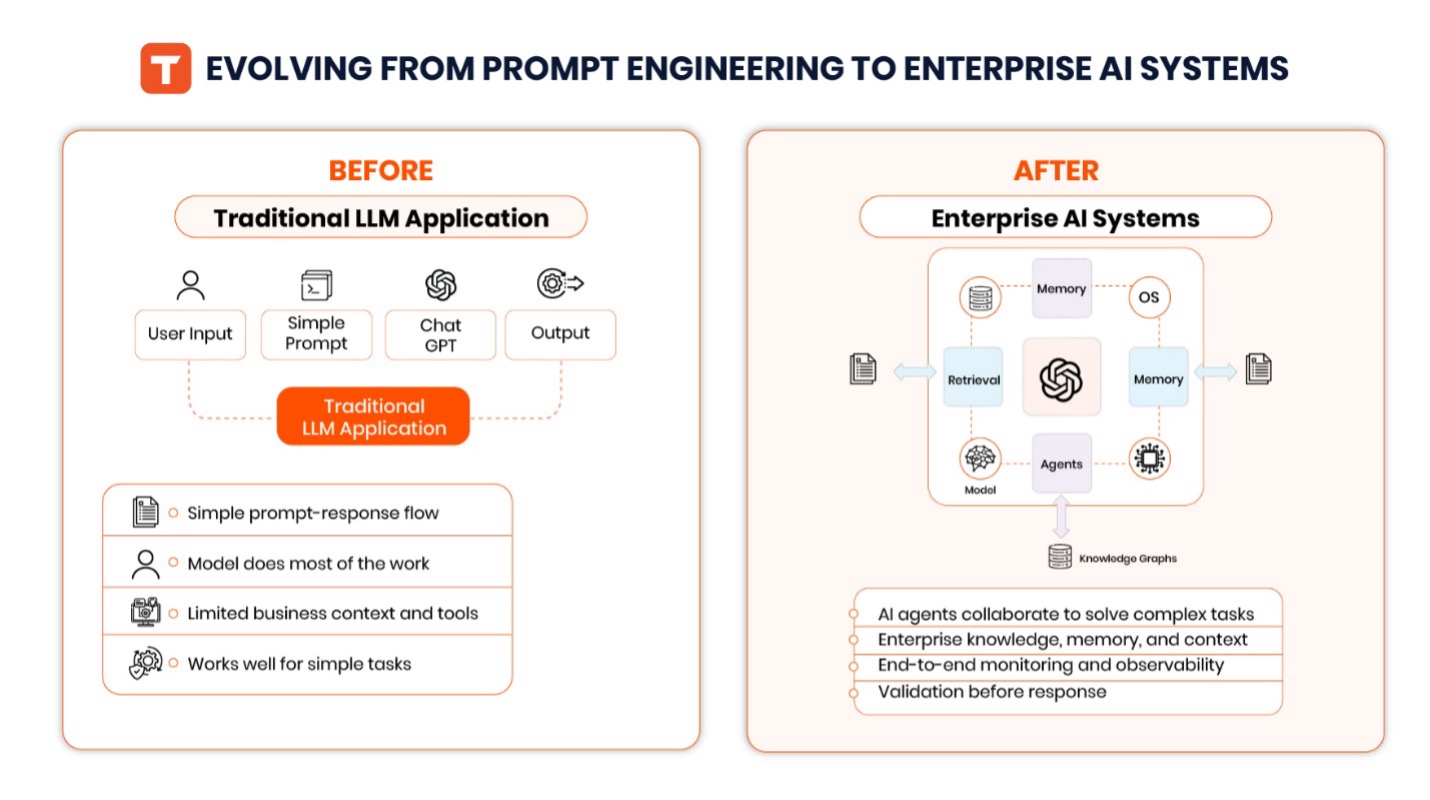
Modern AI systems are no longer a single LLM responding to clever instructions. They retrieve information, maintain memory, orchestrate workflows, apply guardrails, evaluate outputs, and often involve humans before a response reaches the user.
The challenge is no longer just writing a better prompt. It's building a system that consistently gives the model the right information, at the right time, in the right context.
That's why AI engineering is evolving.
The industry is moving through three layers, each addressing a different point of failure:
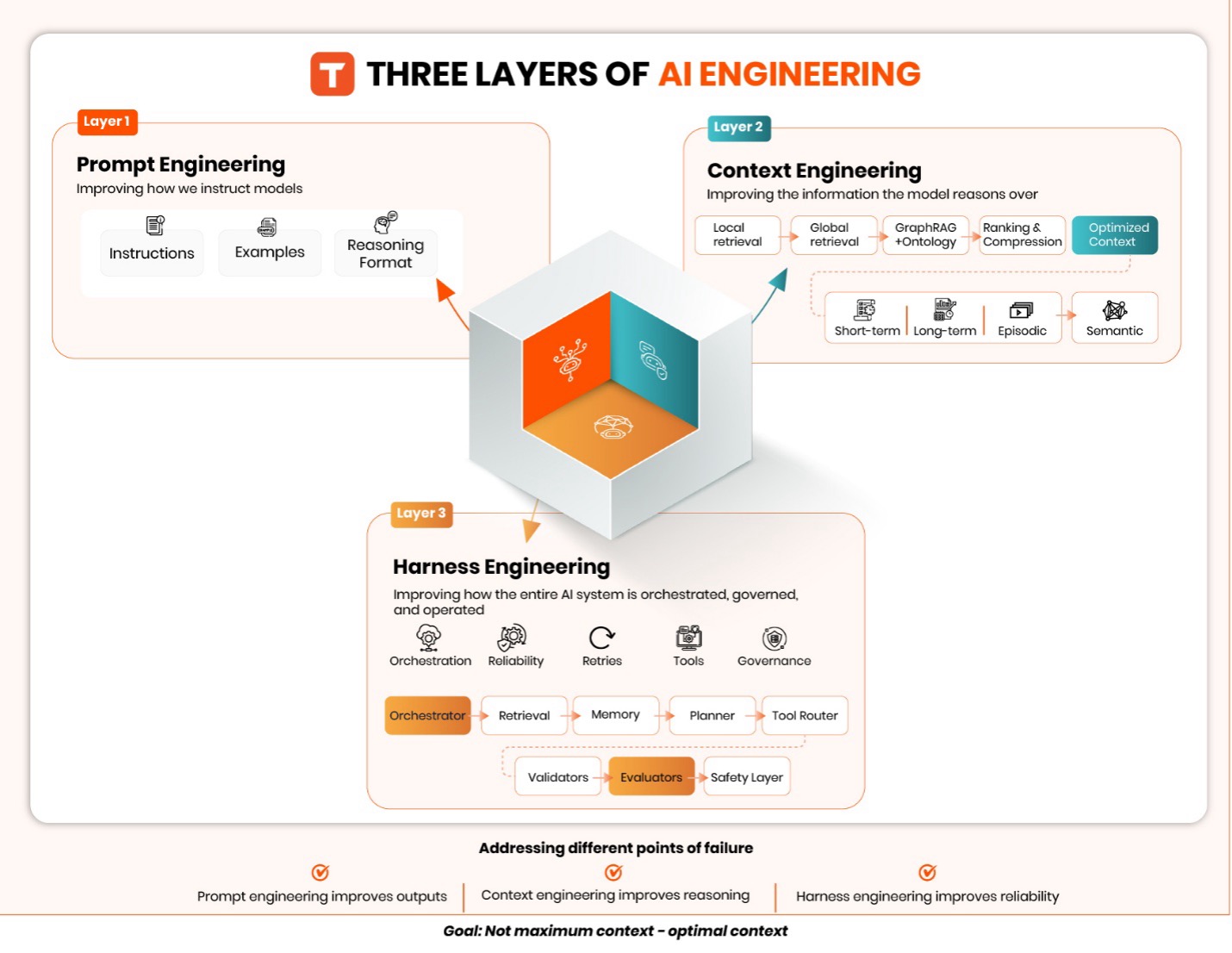
Understanding this progression is the difference between building AI demos that impress and enterprise AI systems that people can trust.
Phase 1: Prompt Engineering
Prompt engineering was the first wave of practical LLM optimization.
The idea was simple: Ask better questions, and you’ll get better answers.
Teams experimented with role prompting, few-shot examples, chain-of-thought reasoning, structured output formats, system prompts, and prompt chaining. These techniques made models significantly more accurate and consistent across a wide range of tasks.
Instead of asking: "Summarize this document."
You'd write:
"You are a financial risk analyst. Summarize the document in bullet points focusing on regulatory risk, operational exposure, and credit concerns."
The difference was immediate.
Prompt engineering became one of the first practical disciplines of generative AI. It showed that how we communicate with a model can have a meaningful impact on the quality of its output.
But as enterprise AI systems became more sophisticated, teams started running into problems that better prompts couldn't solve.
Consider a banking AI assistant helping underwriters review mortgage applications. The prompt might be excellent, but the system could still fail.
Retrieval may pull an outdated policy document, relevant customer history may never reach the model, a table from a scanned PDF maybe parsed incorrectly, earlier reasoning steps may be silently dropped, or two contradictory documents might be retrieved side by side without any way to reconcile them.
None of those failures are caused by the prompt. The model didn't misunderstand the request. It failed because the system around it never gave it the right information at the right moment.
That's an important distinction.
Prompt engineering improves how we communicate with the model. It doesn't control what information the model receives, how that information is retrieved, whether it's complete, or whether it's trustworthy. Those challenges belong to an entirely different discipline.
That's where Context Engineering begins.
Phase 2: Context Engineering
Prompt engineering optimizes instructions. Context engineering optimizes the information the model reasons over how it's retrieved, ranked, compressed, connected, remembered, and validated before it reaches the model.
That may sound like a subtle distinction, but it's one of the biggest shifts happening in enterprise AI today.
It's not simply “attach a vector database to an LLM.” It spans retrieval systems, memory systems, ranking and reranking pipelines, context compression, conversation and workflow state, document chunking, metadata filtering, multimodal inputs, knowledge graphs, and ontologies. A state-of-the-art model with poor context behaves like a brilliant but uninformed intern. A smaller model with excellent context will often outperform it.
Context Engineering in Practice: A Commercial Lending Example
Consider an AI-powered underwriting system at a large financial institution. Its job isn't simply to summarize documents or answer questions. It must evaluate risk, interpret policies, and support decisions that carry real financial consequences.
Here’s how context engineering builds that understanding.
The system starts with borrower’s information.
Multimodal ingestion pipelines process borrower-submitted tax returns, invoices, bank statements, ownership records, and transaction histories. OCR and document intelligence agents extract structured data into platforms like Databricks Delta Live Tables or Snowflake.
A predictive ML agent estimates default probability from debt-to-income ratio, liquidity position, repayment history, and revenue trends, pulled through SQL retrieval layers or enterprise systems like Genie or Cortex. A traditional retrieval layer then surfaces the borrower’s own servicing history, prior underwriting notes, and the specific policy sections that apply to them.
Everything the model sees is directly relevant to this borrower.
A borrower can look healthy in isolation while sitting on hidden risk. They may depend on a supplier already flagged for elevated bankruptcy risk; their sector may be entering a default cycle; a regulatory change may be about to alter their exposure.
Global retrieval pulls in sector-wide stress indicators, interest-rate environments, regulatory updates, and macro signals, so the system reasons across the ecosystem the borrower sits inside, not just the borrower’s own file.
Traditional vector retrieval finds text that’s semantically similar. It doesn’t understand business relationships.
For example, it doesn’t know that two borrowers share the same supplier, belong to the same ownership group, or are both exposed to a counterparty already showing signs of distress.
GraphRAG fills this gap by retrieving connected relationships through a knowledge graph instead of disconnected document chunks. An ontology adds another layer by defining what business concepts such as “counterparty risk” or “liquidity stress” mean operationally, what policies they trigger, which thresholds they cross, and how they influence business decisions.
The system stops retrieving isolated text and starts retrieving business meaning.
Before any context reaches the model, it is filtered, prioritized, and refined.
Metadata-aware filtering weighs document recency, jurisdiction, and confidence.
Hybrid ranking prioritizes verified analyst reports and current policy over stale-but-similar matches.
Summarization and adaptive compression condense lengthy filings and OCR output, so the signal survives the trip through a limited context window.
The goal isn’t maximum context. It’s optimal context governed by salience scoring and intelligent pruning.
Memory powers every stage
Memory isn’t a separate stage in the pipeline; it continuously strengthens context engineering by preserving workflow state, institutional knowledge, previous decisions, and business concepts.
Short-term memory holds active workflow state recent tool outputs, in-progress reasoning.
Long-term meamory holds institutional knowledge and recurring patterns.
Episodic memory holds traces of prior cases past fraud reviews, completed underwriting decisions.
Semantic memory holds generalized concepts, tied back into the ontology and knowledge graph.
Together, these memory layers help mature AI systems balance “what’s happening right now” with “what the organization has learned over time.”
The result is that a final lending decision is no longer a single prompt response. It emerges from predictive ML signals, local borrower context, graph-based ecosystem relationships, compressed market intelligence, and layered memory – all converging before the model reasons at all.
The future of enterprise AI depends less on who owns the largest model and more on who builds the most intelligent contextual infrastructure around it.
Phase 3: Harness Engineering
Great context is only one part of the system. Someone still needs to orchestrate everything around the model: retries, tool calls, failures, audit trail.
That's where Harness Engineering comes in.
If the model is the CPU, the harness is the operating system. Harness engineering is the infrastructure layer that governs orchestration, reliability, retries, state management, observability, security, governance, evaluation, tool execution, agent coordination, fallback behavior, and cost control.
Where prompt engineering optimizes instructions and context engineering optimizes information, harness engineering optimizes the entire operational system around both.
Why Harness Engineering Matters?
Most production AI failures aren’t caused by models. They’re caused by system around it.
For example, a tool call times out. An API returns incomplete data. An agent gets stuck in a loop. A cache serves stale information. A retrieval pipeline fails silently. A permission check blocks access to critical data.
None of these problems can be solved with a better prompt. To solve these problems, teams first need visibility of what’s happening across the entire AI system. That’s where AI observability comes in.
AI observability looks very different from traditional infrastructure monitoring. Instead of CPU, memory, and network latency, engineers need prompt tracing, token usage, retrieval quality scoring, hallucination monitoring, tool-call tracking, reasoning-path inspection, and agent execution graphs.
When something breaks, the question is no longer “Which server is down?” It’s
Which tool failed?
Which document was retrieved?
Which reasoning step went wrong?
Was the context stale?
Did the reranker fail?
Was the system prompt overridden?
Answering these questions require more than monitoring. It requires a different architecture for building enterprise AI systems.
The architecture itself has changed.
The model is now one component inside a much larger system, and often not the largest engineering challenge in it.
An Advanced Example: Cross-Institutional Fraud Detection
Take a real-time fraud detection network spanning multiple financial institutions. Unlike a single bank’s underwriting desk, no single institution has access to the complete picture. Detecting fraud requires multiple AI agents, data sources, and decision systems to work together in real time.
This is where harness engineering does its real work.
If one institution’s API times out mid-transaction, the harness manages retries and fallback path without losing workflow state or double flagging an account. If retrieval quality from a threat intel feed drop, it routes around the stale source rather than reasoning on bad data.
Every reasoning trace, tool call via MCP, and confidence score is logged for after-the-fact audit, because regulators will eventually ask why a specific transaction was frozen and “the model decided” is not an acceptable answer. High-confidence, low-risk cases can be resolved autonomously; ambiguous or high-value cases route to a human fraud analyst, whose decision and rationale feed back into the evaluation pipeline to improve future scoring.
Notice what’s different from the underwriting example: this isn’t one institution retrieving better context about one borrower. It’s multiple autonomous systems, owned by different organizations, that must coordinate, fail gracefully, stay auditable, and respect governance boundaries in real time. That coordination problem, not the model’s intelligence, not even the quality of any single agent’s context is what harness engineering is designed to solve.
Beyond Harness Engineering
Prompt engineering taught us how to work with models. Context engineering taught models how to work with enterprise knowledge. Harness engineering brought everything together into systems that can operate reliably in production.
The next challenge is no longer making AI more capable. It’s making enterprise intelligence part everyday work - closer to the people making decisions, the workflows creating value, and the domain knowledge that rarely exists in documentation alone.
Perhaps that’s where AI engineering is headed.
Not toward bigger models, but toward enterprises where AI understands the business well enough to become a part of it.

