The Paradigm Shift in Digital Commerce: Agentic Commerce 101
You are redecorating your living room. You have a rough budget, a specific aesthetic style in mind, and a comprehensive list of things you need: a sofa, a rug, a coffee table, and some lighting. But every single purchase affects the next in a cascading series of dependencies. The sofa dictates the permissible dimensions of the rug. The rug anchors the foundational color palette for the entire room. The coffee table has to clear the sofa arms by a specific margin for ergonomic comfort. The lighting you loved online looks entirely different against the paint color you have already committed to. Each decision lives on a different website, in a different browser tab, with absolutely no systemic connection to the others. You spend three full weekends on this fragmented journey and still are not entirely sure you got it right.
Now imagine that entire end-to-end journey seamlessly handled by an intelligent, autonomous agent.
You tell it your overarching budget, your nuanced style preferences, the exact spatial dimensions of the room, and the non-negotiables, such as the requirement that the sofa must be pet-friendly and stain-resistant. The agent goes to work, orchestrating the discovery and selection process, and also seamlessly shifts into post-purchase execution tasks. It can actively help you choose furniture within your financial constraints, coordinate logistics with local vendors, schedule complex white-glove installations, and manage payments across various credit options, EMIs, and loyalty rewards programs. It continuously adjusts its recommendations as your financial situation or spatial constraints change.
In the traditional digital commerce model, this journey involves disparate stores, unlinked products, varied retailers, and disconnected service providers. In agentic commerce, a single intelligent software agent manages the entire holistic process by linking financial decisions with commercial actions in real time. Agentic commerce is substantially more than mere consumer convenience. It is a fundamentally new architectural way of transacting in which decisions, purchases, spatial planning, and final outcomes are continuously optimized on your behalf.
What is Agentic Commerce?
Agentic commerce is an advanced AI-driven approach to buying and selling in which intelligent, autonomous agents act on behalf of consumers or B2B enterprises to research, recommend, dynamically negotiate, and complete transactions without requiring constant human intervention. It also intrinsically manages backend tasks like hyper-personalization, proactive customer interactions, and real-time inventory optimization.
The first time you saw Amazon's one-click checkout and realized the checkout process would never be the same, or the first time a customer complained that your website was not mobile-friendly, those were moments when the foundational rules of commerce quietly but permanently changed. We are in the midst of one of those structural paradigm shifts right now.
The primary reason is not only that Generative AI can answer questions in fluent natural language. It is that AI can now autonomously coordinate complex work across the entire commerce tech stack. Product discovery, constraint evaluation, dynamic cart building, payment routing choice, fulfillment logic arbitration, and post-purchase service resolution are no longer isolated customer tasks that require human navigation. They can now be intelligently orchestrated by software that deeply understands user goals, financial constraints, and optimal trade-offs. That creates a fundamentally different kind of buying journey. Instead of forcing customers to do the arduous integration work themselves, the modern enterprise can make the journey directly executable through intelligent systems.
This is precisely why agentic commerce should not be confused with a superficial chatbot refresh or a generative AI wrapper. A chatbot usually just answers a specific query. A recommendation engine usually just ranks historical data. An agent can do exponentially more. It can interpret nuanced intent, call external APIs and tools, reason over complex business policies, sequence multi-step actions, and successfully complete an end-to-end workflow. In other words, the monumental move is from digital commerce designed for human navigation to machine-readable commerce designed for intelligent, autonomous execution.
How AI Agents Think, Plan, and Execute a Purchase
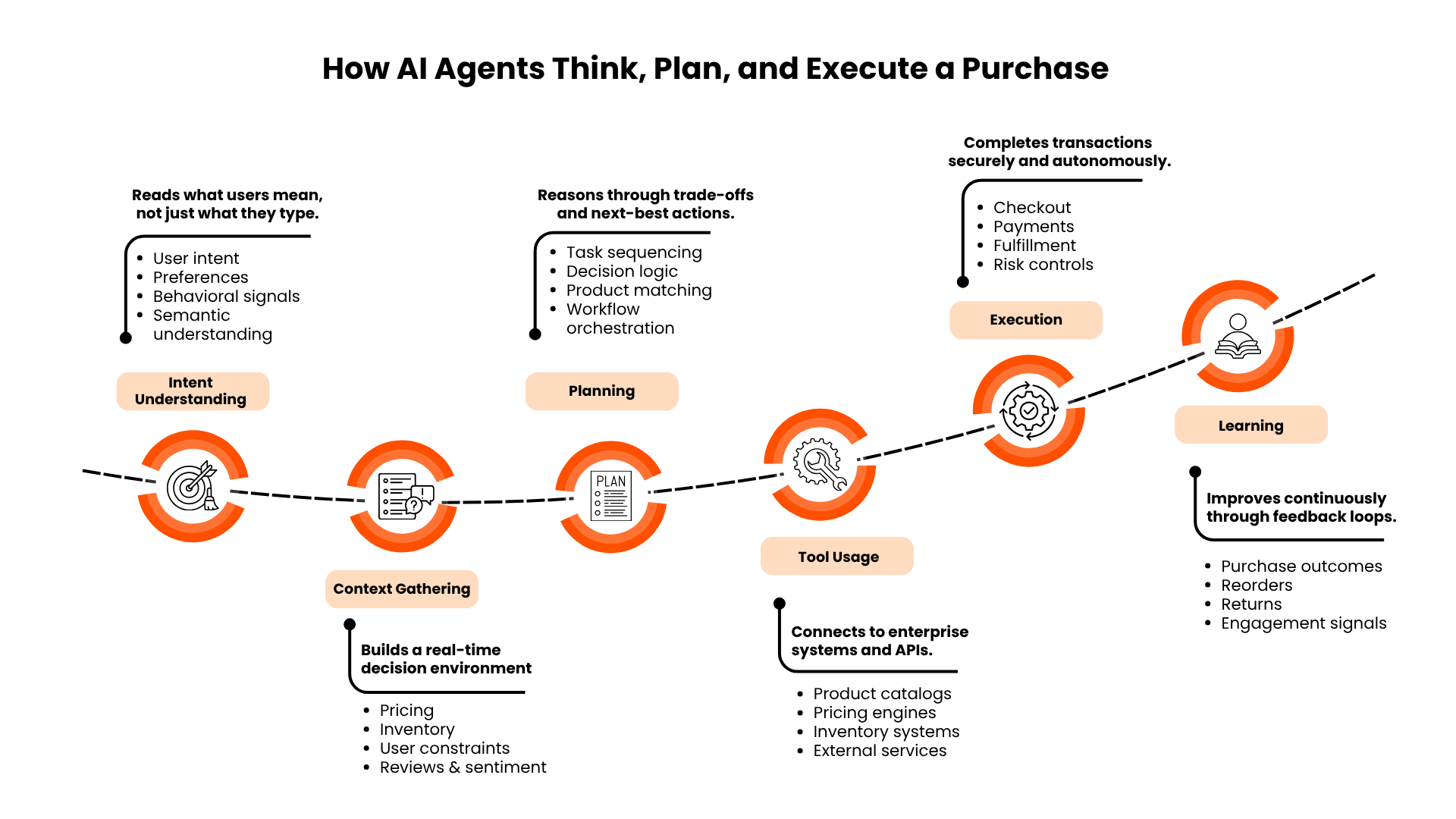
A traditional chatbot reacts linearly to explicit questions. A recommendation engine surfaces products based purely on past behavioral clickstream data. Both are somewhat useful, but neither truly thinks, plans, or acts strategically. An AI agent can do all three, systematically running through six interconnected cognitive stages every time it engages with a customer.
Intent understanding
Intent understanding is the foundational layer where everything starts. The agent reads both explicit signals, such as exactly what the customer typed or spoke, and implicit ones, such as historical browsing context, past transactional purchases, and recently abandoned carts. A customer generically searching "protein powder" and one asking "what helps with muscle recovery after morning runs without spiking blood sugar" could technically want the same product, but the second has provided the agent with everything it needs for a genuinely personal, scientifically grounded recommendation. Of all the unstructured and structured data the agent processes, semantic intent signals are by far the most important.
Context gathering
Context gathering builds the full, multidimensional decision picture. The agent pulls real-time pricing feeds, competitive benchmarking data, live hyper-local inventory, and user constraints like budget caps, dietary restrictions, and strict delivery deadlines while reviewing the data simultaneously. Traditional agents heavily weigh generic review counts and ratings, but sophisticated agentic systems go much further, processing natural language sentiment and recency bias to separate genuinely trusted products from ones merely coasting on old, outdated reputation.
Planning
Planning is where the agent plays a major, transformative role. Rather than simply returning a paginated list of search results, it logically reasons through complex trade-offs, sequences multi-step logistical tasks, and constructs a complete, unified solution. It can also effortlessly handle complex, interrelated requests like assembling a nutritionally balanced weekly meal plan and automatically ordering all the required ingredients across multiple grocery vendors in a single interaction.
Tool usage
Tool usage is how the agent actively connects to the real enterprise world, such as calling product catalog APIs, querying legacy inventory management systems, pinging dynamic pricing engines, and pulling marketplace data in real time, ultimately synthesizing these disparate results into a coherent, actionable recommendation. If the enterprise does not explicitly expose these backend interfaces in a clean, strictly governed, and machine-readable way, the agent becomes fundamentally much weaker and prone to hallucination. That is precisely why so much of agentic commerce is actually about infrastructure readiness and API liquidity rather than just large language model novelty.
Execution
Execution is where the commercial stakes get the highest. When the agent successfully completes a purchase, it utilizes tokenized payments, delegated authority frameworks, and platform-safe transaction controls to securely and compliantly transact on a user's behalf. At this critical stage, the mathematical quality of business rules matters just as much as the semantic intelligence of the model. The system needs to deterministically know the real net price, the valid promotional offer, the optimal logistical fulfillment slot, the authorized cryptographic payment method, and the acceptable fallback substitute when the preferred primary option is unexpectedly unavailable.
Learning
Learning continuously closes the optimization loop. Every single interaction generates valuable feedback from purchase completions, physical returns, reorders, and digital engagement signals. This rich telemetry information flows back into the system's embedding models and makes the next decision algorithmically sharper. This continuous feedback loop is one of the most structurally underappreciated competitive dynamics in agentic commerce. An agent that has been running and learning for two years possesses an insurmountable data advantage that a late-moving competitor cannot replicate quickly, regardless of their capital investment.
What Are the Benefits of Agentic Commerce?
The strategic business case for agentic commerce sits broadly across three core areas, with each compounding heavily over time.
For the customer
For the customer, the digital experience becomes beautifully effortless, since it completely automates the arduous process of the initial search, the multi-tab comparison, the fragmented checkout process, and the post-purchase follow-up. Consumers who are already heavily using AI when searching the internet are not doing this merely because they love new technology. They are doing it because it tangibly saves them hours of time and leads them to demonstrably better decisions, much faster. An agent that genuinely understands a customer's specific needs, intrinsically remembers their historical preferences, and proactively surfaces the absolute right product at the exact right moment does not feel like clunky technology. It feels exactly like having a dedicated, omniscient personal shopper who truly understands what is best for you.
The single most important customer benefit is not transactional speed alone. It is the massive reduction in cognitive load. Customers fundamentally do not want ten more pages of loosely relevant, keyword-matched options. They want a dramatically smaller number of highly curated, better options presented with logically clear trade-offs. In high-consideration categories like grocery meal planning, home improvement spatial design, travel routing, wellness, and complex electronics, this matters enormously because the sheer act of choosing is very often the primary friction point causing cart abandonment. Agentic systems gracefully reduce that friction by making recommendations highly contextual and final outcomes fully complete.
For the retailer
For the retailer, the bottom-line operational benefits are massive and significant. AI agents can comprehensively reclaim thousands of hours currently spent on manual, repetitive operational tasks. This officially frees up buyers, merchandise planners, and category managers to focus purely on high-level strategy, complex supplier relationships, and the nuanced decisions that actually require genuine human judgment.
On the top-line revenue side, agent-driven hyper-personalization consistently and mathematically outperforms legacy segment-based approaches, and agentic semantic search, fundamentally moving from blunt keywords to nuanced intent, has shown highly material improvements in raw conversion rates and overall basket size.
Operationally, agentic commerce also ruthlessly forces better enterprise data discipline. Product taxonomy data needs to improve drastically. Promotional logic needs to be mathematically computable. Inventory availability signals need to be near-real-time fresh. Transactional services need to be exposed in much cleaner, API-first ways. Although this foundational work can often feel heavily infrastructural and unglamorous, it creates massive, enduring commercial leverage. Once the core business logic is perfectly machine-readable and the API interfaces are perfectly clean, the exact same foundation can concurrently power site search, post-purchase service experiences, custom AI shopping assistants, external AI answer engines, and future protocol-based commerce transactions seamlessly.
For the enterprise
For the global business as a whole, the long-term strategic opportunity is absolutely enormous. The enterprises that strategically start earlier build the critical data flywheel earlier. They learn exactly how AI surfaces mathematically represent their brand ontology. They explicitly discover where their product catalog is semantically weak. They deeply understand which complex promotions machines can compute correctly and which ones they structurally cannot. They see clearly where loyalty program logic is getting completely lost in translation. They fundamentally turn infrastructural readiness into an impenetrable structural advantage. McKinsey projects that agentic commerce could generate up to $1 trillion in orchestrated US retail revenue by 2030 and $3 to $5 trillion globally.
The compounding dynamic is deeply worth noting, too. Unlike a one-time ERP or legacy e-commerce platform technology upgrade, agentic systems inherently get better over time. The continuous feedback loop means every single customer interaction mathematically makes the next one slightly more accurate. Retailers who aggressively begin building their structured data flywheel now will definitively have a significant, mathematically insurmountable advantage over those who hesitantly start later.
Challenges and Limitations of Agentic Commerce
The most honest, unvarnished summary of where agentic commerce technically sits today is this: the core AI technology works brilliantly, but the legacy digital foundations most traditional enterprises are sitting on were absolutely not built for it. The vast gap between a successful, highly controlled proof-of-concept pilot and a massive, production-grade enterprise deployment is almost usually not a foundational model gap. It is a severe data gap, a rigid governance gap, or a siloed organizational gap.
Data quality is the most common hidden killer
An autonomous agent making critical financial decisions in real time is fundamentally only as good as the underlying data it draws upon. Product catalogs historically built for human visual browsing are very often poorly suited for programmatic agent consumption. Inventory data that batch-updates only every few hours is practically useless and not good enough when an agent is trying to make a real-time, zero-latency purchase recommendation. Customer data completely scattered across five disconnected CRM and legacy systems without a unified, single view can make genuine, context-aware personalization mathematically impossible.
The severe problem is not just missing database fields. It is a fundamental semantic weakness. Many legacy catalogs still describe products just well enough for a human person to visually browse, but not nearly well enough for a sophisticated machine to logically reason. If the intelligent system cannot definitively tell whether a food item is certified gluten-free, what other exact products it perfectly complements, whether it currently qualifies for a highly particular seasonal offer, or whether a hyper-local, store-level fulfillment promise can be made with high confidence, the agent just ends up hallucinating and guessing.
Governance is non-negotiable
When an AI agent is effectively making purchasing and financial decisions autonomously, strict corporate accountability becomes a very real, legal question. Who is precisely responsible when the autonomous agent makes an expensive mistake? How do you effectively audit a complex decision that was computed in milliseconds across a dozen disparate API data sources? The forward-thinking enterprises succeeding in this space are aggressively building deep auditability logs, strict human-in-the-loop escalation protocols, strict financial approval thresholds, and extremely clear corporate ownership structures long before they attempt to scale.
Trust has to be earned on both sides
Consumers absolutely need to trust that an AI agent acting on their behalf will get the complex details right, and that when it inevitably does not, the customer service resolution will be phenomenally fast and completely fair. Conversely, merchants need to cryptographically trust that incoming agent traffic is completely authentic, strictly operating within authorized API scopes, and handling highly sensitive identity and tokenized payment data flawlessly and securely.
Customers need to trust that an agent acting on their behalf will get it right and that when it doesn't, the resolution will be fast and fair. Visa has recorded a 450% spike in dark-web activity around AI agent fraud tools (Source). The massive protocol infrastructure for verifying that an external agent is strictly legitimate, acting safely within its delegated user authority, and interacting securely with legacy payment gateways is still being actively built and standardized.
The operating model must change
The very good news is that absolutely none of these complex challenges is fundamentally insurmountable. These are highly solvable engineering and organizational gaps that simply require a brutally honest architectural assessment before you start writing code. But that last specific phrase heavily matters. Agentic commerce absolutely does not fail because massive organizations lack strategic ambition. It fundamentally fails because entirely different, siloed teams separately own product content, dynamic pricing, customer loyalty, post-purchase service, core APIs, cybersecurity, and digital front-end experience in complete isolation. Agentic systems seamlessly cut right across all of them. Without a unified, cross-functional operating model, the massive organization can easily produce a visually impressive sandbox pilot and still completely miss enterprise production viability.
Agentic Commerce Experiences: How Intelligent Systems Redefine Digital Commerce
The aggressive shift toward agentic commerce is a massive, fundamental reimagining of exactly how top brands create, serve, and sustain long-term digital experiences.
Where legacy traditional digital commerce relied heavily on:
- Static pagination catalogs
- Highly brittle rules-based chatbots
- One-size-fits-all landing pages
Modern agentic systems are dynamically generated, deeply context-aware, and highly capable of autonomously acting on behalf of both global brands and individual customers. The following distinct experiences represent the absolute leading edge of this digital transformation across owned enterprise channels.
Experience 01 Contextual Semantic Search on Owned Channels From a fragmented, multi-tab journey to one intent-aware orchestrated flow
In the legacy traditional model, a customer's shopping journey was completely fragmented by structural design. They might:
- Initially discover a cool product on Google
- Heavily research it on a Reddit forum
- Check the lowest pricing on an Amazon marketplace
- Finally purchase it on the actual brand's direct website
Each discrete step lived in a completely different ecosystem system, rigidly owned by a completely different tech platform, without a shred of unified intelligence connecting them.
From Fragmentation to End-to-End Orchestration
A modern agentic experience completely changes that massive fragmentation. A single, natural language input like "I need a lightweight, waterproof running jacket for cold weather under $120" immediately triggers a massive end-to-end orchestration. The agent:
- Deeply understands the semantic intent
- Seamlessly searches across all relevant internal data sources
- Strictly applies the financial and feature constraints
- Checks real-time hyper-local inventory
- Dynamically surfaces a highly shoppable, perfect recommendation in one single, fluid flow
For enterprise retailers, this definitively means the strategic battleground has moved. Simply winning traditional SEO on Google is absolutely no longer sufficient. Winning visibility inside massive answer engines and AI shopping surfaces requires a fundamentally different, data-first strategy. The core question is absolutely no longer, "how do we rank highly?" It is "how do we get definitively selected by the algorithm."
Why Product Data Is the Foundation
Search accuracy is fundamentally only as good as the underlying, structured product data. Agentic commerce aggressively demands:
- Highly rigorous product enrichment with deep structured attributes
- Specific use cases
- Nuanced persona tags
- Rich contextual metadata in a highly specific form that modern embedding models can actually effectively index
Legacy products described only by a basic SKU, a color, and a price point are effectively completely invisible to modern vector-based search engines.
Real-Time Behavioral Signals on Top of Semantic Retrieval
The absolutely most capable enterprise implementations dynamically layer real-time behavioral signals directly on top of semantic vector retrieval. Live clickstream data — exactly like what specific users browsed, hovered their mouse over, briefly added to the cart, and eventually abandoned — directly feeds real-time reranking machine learning models that instantly adjust the specific result ordering based heavily on the active session's rapidly emerging intent.
Experience 02 Multimodal Shopping and Service Assistants Text, image and voice, unifying pre- and post-purchase in one interface
The most advanced multimodal shopping system intrinsically understands raw text, uploaded image, and spoken voice inputs completely simultaneously, seamlessly decomposes highly complex user queries into logical sub-intents, and resolves them all instantly.
Hybrid Retrieval at Scale
A highly sophisticated hybrid retrieval layer flawlessly combines:
- Legacy keyword-based lookups for highly precise filtering by exact size, specific price, and store availability
- Advanced vector search for deep semantic product discovery
A highly complex query exactly like "I need an amazing gift for my older sister who deeply loves minimalist Scandinavian aesthetics and intense outdoor winter activities" is instantly decomposed into logical sub-intents precisely such as:
- Specific aesthetic preference
- Exact recipient profile
- Contextual occasion type
It then flawlessly resolves them all in massive parallel before being beautifully synthesized into a highly ranked, personalized recommendation set.
The Unified Pre-Purchase and Post-Purchase Agent
What practically makes these modern assistants genuinely powerful is the flawless unification of both pre-purchase shopping and post-purchase service use cases within a single, elegant interface.
The exact same AI agent that easily helps a confused customer discover and highly configure a complex product can also:
- Instantly check live order shipping status
- Seamlessly initiate a complex return
- Appropriately escalate a severe complaint to a human without any clunky handoff
This absolutely requires incredibly deep backend API integration. The AI assistant must flawlessly query:
- The CRM for deep customer history
- The OMS for precise order data
- The legacy ERP or inventory microservices for real-time stock state
Experience 03 Hyper-Personalized Content Generation on Websites and Apps Every page element assembled live for the current micro-moment context
Personalization in absolutely most traditional organizations today is incredibly historical and basic: roughly segment a web user by their past three purchases, show them somewhat relevant category hero banners, and slightly adjust homepage product tiles by a basic affinity cluster.
True agentic commerce aggressively pushes toward real-time, hyper-session-aware dynamic content generation, where absolutely every single element of a digital page is dynamically assembled on the fly in direct response to the absolute current, micro-moment context.
Reimagining the Product Detail Page
Consider the standard e-commerce product detail page (PDP). In a legacy static model, one identically written description rigidly serves absolutely every single visitor.
In a modern agentic model, the exact same core product dynamically generates a completely different, tailored narrative for:
- A hesitant first-time buyer
- A highly loyal repeat VIP customer
- A ruthless high-intent comparison shopper
The highly specific description is dynamically generated or intelligently selected exactly at render time strictly using advanced content models deeply trained on the specific brand's exact tone of voice and core product data.
The Enterprise Integration Challenge
This profound capability seamlessly extends to:
- Entire homepages
- Dynamic category landing pages
- Personalized promotional hero banners
- Complex product carousel logic
The true operational challenge for the enterprise is absolutely not whether this generative content can be technically produced by an LLM. It is exactly how that massive content generation layer seamlessly integrates with:
- The corporate DAM
- The legacy CMS
- The strict merchandising business rules
- The rigid legal constraints
- The real-time analytics platforms
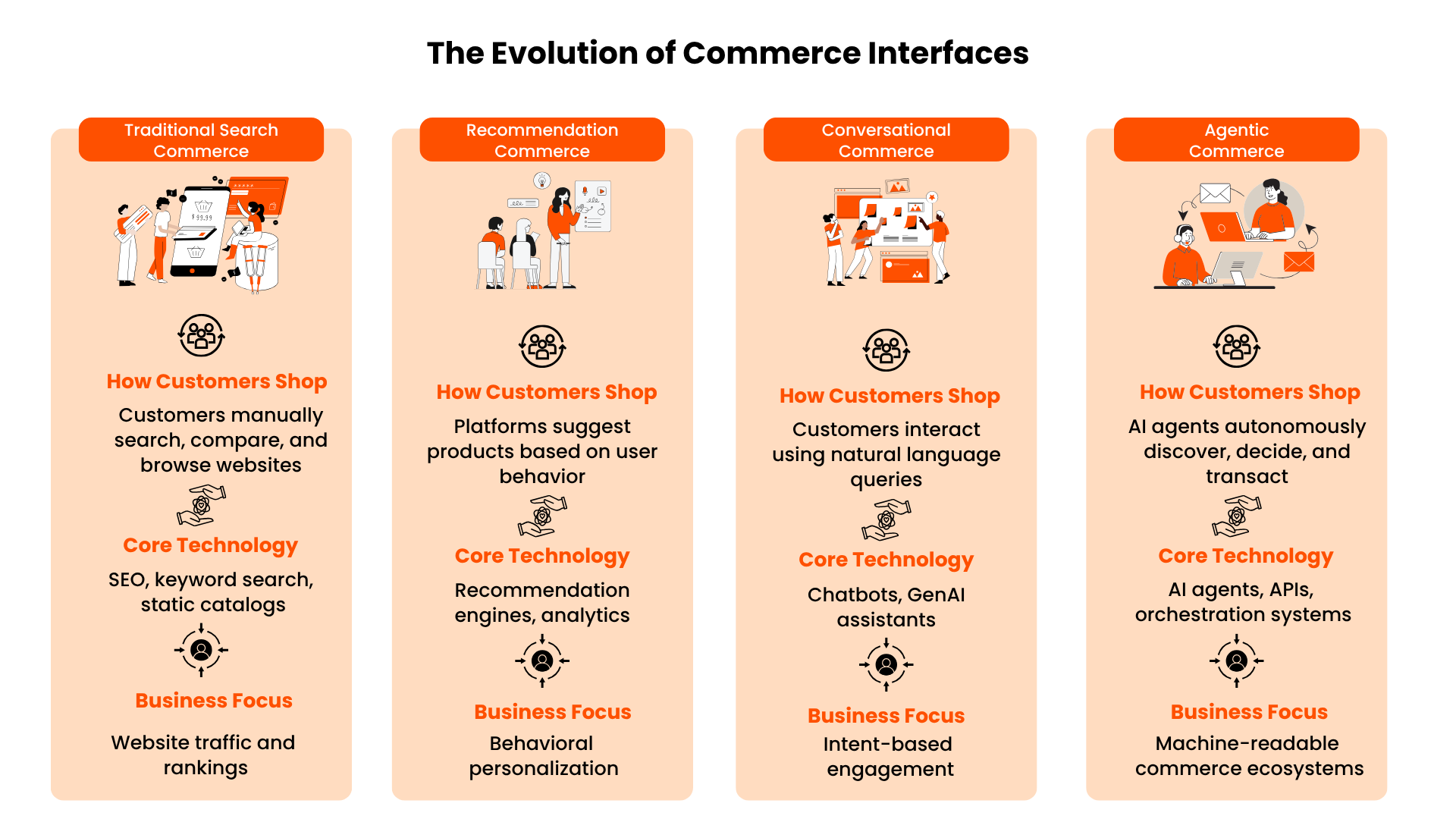
Agentic Commerce Beyond Owned Channels
As global user behavior massively shifts toward AI-driven search and discovery, digital commerce is fundamentally no longer rigidly confined to traditional brand websites and mobile apps. Increasingly, massive discovery and complex decision-making happen seamlessly within third-party conversational interfaces and massive global answer engines.
Answer Engine Optimization (AEO)
As modern consumers increasingly begin their entire shopping journeys by simply asking AI assistants (like ChatGPT, Claude, or Perplexity) rather than typing fragmented keywords into Google, the massive strategic battleground for corporate brand visibility has completely shifted. Answer Engine Optimization, or AEO, is the highly technical discipline of structurally ensuring that your specific products and brand content consistently appear highly recommended within AI-generated narrative answers.
The strict structural architectural requirement is incredibly clear: modern AI models surface their information directly drawn from highly structured, perfectly machine-readable web content. Major brands without perfectly well-formed JSON-LD schema markup, exceptionally clean product data APIs, and highly authoritative, highly cited content signals are completely and systematically less visible in massive AI-generated responses. This massively reduces corporate reliance on traditional, legacy search ranking while dramatically raising the absolute stakes for pure data quality and deep content authority directly at the source.
Generative Engine Optimization (GEO)
GEO goes a massive, highly strategic layer deeper than standard AEO. Where AEO is primarily about simply being found by the crawler, GEO is entirely about being represented highly accurately and exceptionally favorably in the final output. When an advanced AI model synthesizes a highly complex recommendation deeply comparing three different running shoes, GEO heavily influences the exact narrative it produces, the specific framing, the exact product attributes it chooses to emphasize, and the specific competitive comparisons it actively draws.
Smart brands that strategically invest heavily in GEO structurally ensure their core product content is perfectly structured strictly using robust schema, rigorously maintain highly consistent attribute data across all syndication channels, and heavily publish highly authoritative, deeply technical content that major AI models preferentially love to cite. The ultimate corporate goal is to structurally ensure the underlying core data the massive model consumes is perfectly accurate, exceptionally complete, and strictly aligned with the overarching brand intent.
Agentic Storefronts within AI Platforms
The absolute logical extension of both AEO and GEO is the strategic establishment of highly native, seamless brand experiences directly inside the massive AI platforms themselves. Agentic storefronts directly embed live product catalogs, complex 3D configurators, deep loyalty program integrations, and highly authenticated, secure purchase flows directly within the third-party AI interfaces, entirely enabling seamless discovery, deep evaluation, and final transaction without ever redirecting the user back to a traditional brand website.
This represents a massive structural paradigm shift from legacy website-centric to massive platform-centric digital commerce. The corporate website is absolutely no longer the default, required venue for deep customer relationships. The third-party AI interface now actively participates directly in that valuable relationship. For massive global enterprises, this urgently raises entirely new, highly complex questions about merchant-of-record (MoR) legal control, secure identity linking, advanced protocol readiness, and exactly how long-term brand equity value is safely preserved when the digital front-end is no longer fully owned by the brand. Perplexity launched "Buy with Pro," allowing users to browse products and complete one-click purchases directly from select merchants. It subsequently integrated a behind-the-scenes connector that allows merchants to easily link to Perplexity. (Source)
Agentic Engine Marketing (AEM)
Just as legacy search engine marketing (SEM) aggressively evolved to capture highly lucrative paid visibility directly in Google keyword results, AEM rapidly captures highly lucrative paid placements directly within AI-generated narrative responses and massive conversational interfaces. Highly sponsored product appearances directly inside core answer layers and heavily promoted product recommendations surfaced by AI shopping agents are the very early, incredibly lucrative expressions of this massive new digital channel.
The deep strategic implication for the modern CMO is a strict dual-track approach: massive organic visibility strictly through AEO and GEO on one strategic axis and highly targeted paid discovery strictly through AEM on the other. This perfectly mirrors the legacy SEO and SEM dynamic but fundamentally operates entirely within highly dynamic AI environments.
The Unifying Foundation Across Experiences
Absolutely every single agentic experience described above draws heavily on the exact same underlying digital infrastructure. A massive, shared omnichannel data layer perfectly unifies highly granular product attributes, rich customer profiles, and real-time contextual signals directly into a highly consistent, instantly queryable mathematical representation. A massive intelligence layer deeply built on rich vector embeddings, massive vector indices, and highly tuned intent classification models flawlessly translates this raw data into incredibly precise experience-level decisions. A robust, highly resilient integration layer seamlessly connects to the legacy CRM, massive OMS, giant ERP, complex loyalty engines, secure payment gateways, and massive external AI platforms strictly through exceptionally clean, highly versioned modern APIs.
Absolutely without this rock-solid technical foundation, agentic AI experiences are merely isolated, brittle sandbox experiments. With it, they compound massively. Each entirely new digital experience intrinsically benefits from the exact same deeply enriched data and massive shared intelligence that seamlessly powers all the others.
The Tredence Agentic Commerce Readiness Accelerator: The Capabilities That Power Experience
The strongest enterprise accelerator frameworks do not simply list generic capabilities. They explicitly explain exactly how deep architectural readiness is diagnosed, measured, and systematically converted into highly specific engineering action. The Tredence Accelerator combines three sophisticated instruments: deep technical diagnostic tests, pre-curated commercial metrics and KPIs, and incredibly prescriptive engineering remediation actions spanning data architecture, content taxonomy, API liquidity, corporate governance, and digital experience design.
The ultimate purpose of this rigorous structure is to ensure the enterprise can rapidly rebuild and transition from observation to full-scale production implementation without losing a shred of momentum. Below are the six core pillars that define the Readiness Accelerator, organized with their critical diagnostic tests highlighted for immediate engineering focus.
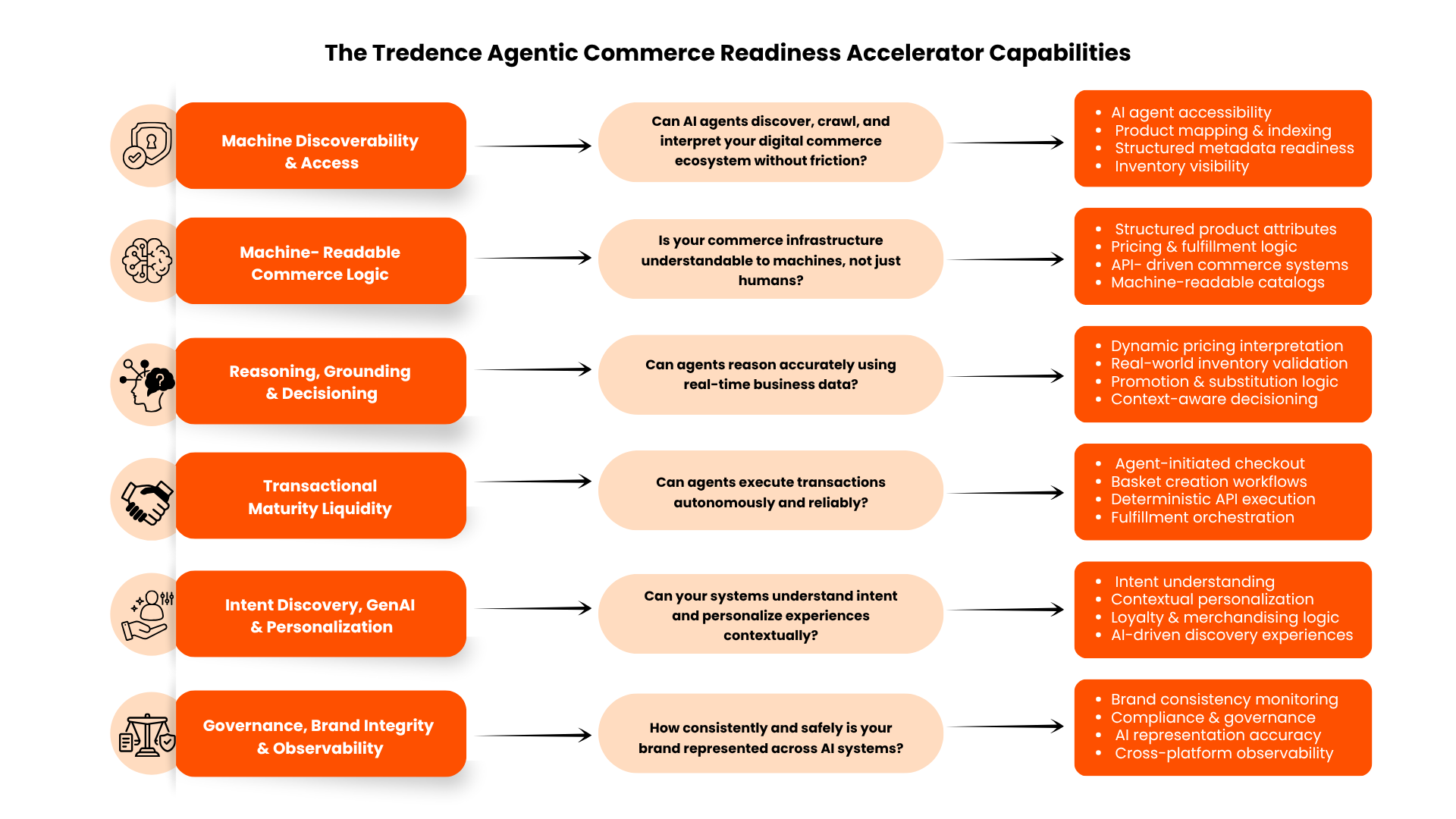
01 Pillar 1Machine Discoverability and Access
This pillar evaluates whether your digital ecosystem is intentionally legible to external AI agents or only discoverable through brittle inference and legacy scraping. Before an agent can transact, it must be able to securely and rapidly map the enterprise's assortment, availability, and value proposition without ambiguity.
Highlighted Diagnostic Tests:
- Agent Crawl Simulation Test: We deploy non-JavaScript, headless bots simulating major LLM crawlers (e.g., GPTBot, ClaudeBot) to identify exactly where firewall throttling, strict robots.txt rules, or poor sitemap architecture block AI ingestion.
- JavaScript Rendering Dependency Test: Compares the payload a traditional human browser sees with what a headless agent sees. If core product data, pricing, or availability relies heavily on client-side JS rendering, it is functionally invisible to most AI indexers.
- Discovery Endpoint Validation Test: Audits the presence and accuracy of .well-known machine discovery endpoints and explicit AI plugin manifests, ensuring the enterprise explicitly declares its intent to be crawled by agentic services.
02 Pillar 2Machine-Readable Data and Schemas
This pillar assesses whether product, pricing, and fulfillment data can be reliably computed by machines rather than merely visually displayed. Catalogs built for human eyes lack the semantic rigor required for autonomous LLM decision-making. AI agents require explicit, mathematically sound structured data to avoid hallucination.
Highlighted Diagnostic Tests:
- Schema Completeness & Extraction Scan: Rigorously scans millions of URLs to measure the exact fill-rate and integrity of JSON-LD microdata. It specifically checks for advanced properties beyond basic price and SKU, such as dietary constraints, spatial dimensions, and specific compatibility matrices.
- Pricing Math Validation Test: AI agents often fail when encountering tiered pricing or multi-buy logic (e.g., "Buy 2 Get 1 Free with Loyalty Card"). This test validates whether highly complex promotional offer metadata can actually be interpreted and computed flawlessly by a headless machine.
- Nutritional & Spatial Semantic Audit: Specifically for grocery and home improvement sectors, this test determines if an agent can reliably deduce if a food item is gluten-free, or if a specific appliance requires custom voltage, without relying on unstructured text descriptions.
03 Pillar 3Reasoning, Grounding, and Decisioning Rules
This pillar determines how accurately AI agents resolve interacting, conflicting business rules under real-world complexity. An agent must behave like a reliable commerce layer, respecting substitution logic, multi-tier loyalty discounts, and strict brand constraints, rather than acting as a highly fluent guesser.
Highlighted Diagnostic Tests:
- Promo Stacking Conflict Test: Simulates highly complex cart scenarios where loyalty tier pricing, seasonal dynamic coupons, and base pricing collide. The test verifies if the agent's logic perfectly reconciles the lowest legitimate price without violating internal margin rules.
- Substitution Logic Resolution Check: In scenarios where an item goes out of stock mid-session, this test validates if the embedding models perfectly preserve strict own-brand preference (e.g., substituting a private-label item over a national brand) while keeping strict dietary or spatial constraints flawlessly intact.
- Brand Safety & Hallucination Risk Test: Puts live AI systems against complex business questions to measure narrative drift and hallucination risk, explicitly testing if the agent invents non-existent fulfillment promises or incorrect return policies.
04 Pillar 4Execution Capabilities and API Liquidity
This is the transactional maturity layer. It evaluates the ability of the enterprise's API stack to safely and deterministically support autonomous, agent-initiated actions. If APIs only expose basic state and lack the capacity for delegated checkout, the enterprise cannot move from agentic guidance to agentic execution.
Highlighted Diagnostic Tests:
- Simulated Basket Stress Test: Validates if cart, dynamic pricing, and legacy inventory microservices exist in a perfectly composable, API-first form capable of handling asynchronous multi-agent orchestration.
- Checkout API Latency & Idempotency Test: AI agents operating in parallel can create race conditions. This test rigorously checks if checkout endpoints handle idempotency correctly, ensuring a temporary network timeout doesn't result in an agent double-charging a customer or dropping a cart.
- Store-Level Fulfillment Logic Validation: Checks if the integration layer explicitly exposes deep algorithmic decisioning logic — such as hyper-local store availability, delivery slot reservation logic, and fallback options — to the external agent in real time.
05 Pillar 5Intent Discovery, GenAI, and Personalization
This pillar assesses whether personalization and brand differentiation persist when the commerce journey is mediated by external AI. Many organizations personalize well on their own websites but lose all signaling once the customer begins their journey in a third-party AI answer interface.
Highlighted Diagnostic Tests:
- Semantic Retrieval Precision Test: Evaluates the vector search engine's ability to accurately map highly nuanced, long-tail multi-modal queries (text and image combined) to the exact relevant SKUs without defaulting to basic keyword fallback.
- Dynamic Content Assembly Audit: Checks the real-time capability of the enterprise's content management system to dynamically generate tailored PDP narratives for different user personas based on micro-moment context.
- Multi-Turn Context Retention Test: Simulates a long, complex shopping journey spanning dozens of interactions to test whether the agent accurately retains spatial, budget, and preference constraints across the entire multi-turn session.
06 Pillar 6Governance, Security, and Brand Observability
When AI agents make autonomous purchasing decisions, governance is non-negotiable. This pillar evaluates the enterprise's ability to manage, monitor, and audit AI-mediated commerce interactions at scale, ensuring absolute legal compliance and data security.
Highlighted Diagnostic Tests:
- AI Referral & Attribution Detection Test: Validates whether the enterprise's analytics and multi-touch attribution infrastructure can successfully separate normal human digital traffic from massive, "dark funnel" agent-mediated AI traffic, attributing revenue correctly.
- Sensitive Data Exposure Risk Test: Audits API responses to ensure that agents operating on behalf of a user do not accidentally access or expose Personally Identifiable Information (PII) or tokenized payment data beyond their strictly delegated authority scope.
- Data Freshness SLA Compliance Test: Validates the strict latency between inventory/price updates in the core ERP and the exposure of that data to the API layer, ensuring agents do not transact based on stale, hours-old batch data.
The Protocol Layer: MCP, ACP, and UCP
How Global Enterprises Should Deeply Think About MCP Implementation
Model Context Protocol (MCP) implementation absolutely must begin strictly with incredibly tight scoping, absolutely not massive public API exposure.
The massive enterprise absolutely must ruthlessly decide exactly which legacy tools and massive datasets are highly valuable enough to be incredibly useful to external AI applications, yet strictly bounded enough to be exceptionally cryptographically safe.
In absolutely most major commerce environments, the incredibly critical first wave rigorously includes:
- Highly enriched catalog lookup APIs
- Exceptionally fast availability and complex fulfillment checks
- Perfect deterministic price and dynamic promotion resolution
- Highly selected customer-context database lookups strictly where explicit legal consent and strict corporate policy absolutely permit
These are the incredibly exact contexts that modern AI agents critically need most often, and they are exactly the ones that massively reduce the highest volume of incredibly brittle, highly custom API integrations.
Creating Secure MCP-Friendly API Wrappers
Once those incredibly specific contexts are strictly selected, the exact next massive step is to rapidly create highly MCP-friendly, exceptionally secure API wrappers perfectly around existing legacy microservices.
The massive enterprise absolutely does not need to completely replace its highly functional existing APIs. It simply needs to flawlessly make them incredibly easier for highly autonomous AI systems to perfectly consume strictly through a highly common, standardized tool and context architectural pattern.
Absolutely each highly secure wrapper absolutely must strictly define:
- Incredibly complex cryptographic authentication
- Perfectly permissible CRUD operations
- Highly explicit JSON response shape
- Strict versioning
- Massive technical telemetry
Why Observability Is Non-Negotiable
This matters incredibly because an MCP API integration absolutely without highly detailed, massive observability is incredibly difficult to legally govern.
If an autonomous AI assistant horribly resolves a critical price incorrectly, the massive business absolutely needs to deterministically know:
- Exactly which legacy tool it called
- Exactly what highly specific rule engine version horribly returned the bad result
- Exactly whether the massive error explicitly came from bad data, from highly flawed policy, or from terrible AI orchestration
How Global Enterprises Should Deeply Think About ACP Implementation
Agent Communication Protocol (ACP) fundamentally becomes massively valuable precisely when global commerce explicitly moves from one highly monolithic AI assistant doing absolutely everything to a massive, highly coordinated neural network of specialized AI agents that flawlessly hand incredibly complex work to one another.
The Right Architectural Pattern
The absolutely most highly effective architectural pattern is definitively not to blindly create dozens of random agents. It is to rebuild and architect a highly sophisticated coordinating central layer plus a very small, incredibly powerful set of deep specialists with incredibly sharply defined legal and technical responsibilities:
- Pricing agent: strictly validates the absolute final cart price
- Loyalty agent: flawlessly resolves incredibly complex benefit eligibility
- Fulfillment agent: ruthlessly reasons over massive hyper-local inventory, delivery slot availability, and perfect replacement options
- Customer service agent: flawlessly manages highly complex order-state changes and massive financial remediation
This incredibly strict, decoupled architecture massively reduces operational ambiguity and makes the incredibly complex overall system exponentially easier to strictly technically test.
Rigid Message Contracts and Distributed State Management
The absolutely massive technical discipline in strict ACP implementation completely lies in highly rigid message contracts and flawless distributed state management.
Absolutely each multi-agent handoff absolutely must strictly define:
- Exactly what highly specific context is required
- Exactly what mathematically deterministic outcome is expected
- Exactly what happens on a massive system timeout
- Exactly how incredibly complex automatic retries should behave
- Exactly when a real human absolutely must be brought into the highly sensitive loop
Why ACP Handles Commerce Exceptions Better
Global commerce is heavily full of incredibly long-running async flows and massive technical exceptions:
- A highly specific item may horribly go out of stock exactly after massive basket creation
- A critical payment authorization may horribly fail exactly after highly complex delivery slot selection
- A highly specific AI substitution may horribly violate a strict medical dietary rule
Strict ACP-style multi-agent coordination is incredibly useful precisely because it perfectly allows these highly specialist micro-decisions to be perfectly managed with absolute 100% traceability strictly instead of being horribly hidden directly inside a single, massive, incredibly opaque LLM prompt.
How Global Enterprises Should Deeply Think About UCP Implementation
Universal Commerce Protocol (UCP) implementation is absolutely best approached as an incredibly highly structured, deeply governed API exposure program exclusively for highly core commerce capabilities.
Start With a Deep Capability Inventory
The absolute highly critical first massive discipline is incredibly deep capability inventory.
Before publishing any highly public discovery UCP profile, the massive enterprise absolutely must rigorously map exactly what it can technically strictly support perfectly through highly headless microservices rather than heavily through legacy digital pages.
Critical questions the enterprise must answer:
- Can incredibly complex checkout API sessions be perfectly created and highly updated 100% deterministically?
- Can secure customer identity be flawlessly cryptographically linked exclusively for highly complex loyalty-aware autonomous transactions?
- Can incredibly detailed legacy order status and massive post-purchase events be flawlessly retrieved 100% reliably?
- Are extremely complex local tax, massive hidden fee, and dynamic messaging outcomes perfectly stable enough to rigorously expose far beyond the legacy website?
This incredibly massive inventory completely tells the global business exactly whether it is truly UCP protocol-ready or still horribly legacy front-end dependent.
The Agentic Maturity Model: Your 90-Day Implementation Roadmap
The massive global enterprises successfully gaining the absolute most massive ground in highly advanced agentic commerce are fundamentally those that have strictly structured their incredibly complex multi-year journey perfectly against an exceptionally clear, highly sequenced 90-day technical roadmap.
30 Days: Massive Foundation, Deep Diagnostic, and Strict Strategic Alignment
The absolute highly critical first 30 days are completely about:
- Perfectly establishing an incredibly accurate, highly quantified mathematical picture of exactly where the massive enterprise technically stands
- Flawlessly creating the incredibly strict strategic and massive organizational conditions for absolutely everything that technically follows to massively succeed
The Core Focus of Days 1–30: This phase centers completely on rigorously running highly structured, incredibly deep agentic AI readiness diagnostics massively across all highly critical six architectural pillars via the Tredence Accelerator.
90 Days: Highly Controlled Pilot Deployment and Massive Commercial Validation
With the incredibly deep baseline diagnostic perfectly complete and all highly massive foundational data gaps aggressively addressed, the highly critical next massive phase flawlessly focuses perfectly on successfully deploying highly advanced agentic AI capability exactly in:
- Two to three incredibly bounded, exceptionally high-value legacy commerce workflows
- Highly selected precisely for highly measurable massive commercial financial impact
- Perfectly achievable technical infrastructure requirements
Conclusion
The incredibly massive, fundamental journey from a highly traditional legacy digital commerce model to an incredibly advanced, highly autonomous agentic AI model flawlessly represents a truly massive, historic structural change in exactly how global digital financial transactions mathematically work. We are aggressively moving away from a slow, legacy time when frustrated consumers had to do all the arduous cognitive work of manually finding, comparing, and coordinating disparate digital services. Now, highly advanced forward-thinking brands will increasingly, aggressively use their highly structured core data, exceptionally clean APIs, mathematically perfect business rules, and incredibly intelligent autonomous agents to flawlessly solve highly complex customer problems incredibly proactively.
As we clearly saw with the incredibly simple, yet structurally complex task of completely redecorating an entire living room, the absolutely massive core financial value of advanced agentic commerce completely lies in the incredible, highly autonomous digital coordination mathematically involved. For massive global retailers, highly iconic brands, and massive digital marketplaces, the absolute true future strategic advantage is absolutely not merely in simply having a highly digitized product catalog or a highly recognizable brand name. It is entirely incredibly easily discoverable to headless machines, flawlessly understandable to highly complex embedding models, perfectly executable strictly through exceptionally clean API interfaces, and highly legally governable massively across incredibly disparate AI-mediated surfaces.
That is precisely why agentic commerce is ultimately a massive, highly technical infrastructure readiness question.
The global organizations that aggressively begin rapidly building that incredibly complex architectural readiness right now will definitely be the exact ones most highly likely to massively win completely across highly owned digital experiences, massive global AI answer engines, massive external third-party AI assistants, and highly native AI agentic storefronts. They will be mathematically exponentially easier for machines to deeply discover, infinitely easier for algorithms to highly recommend, profoundly easier for customers to deeply trust, and flawlessly easier for autonomous agents to financially transact with.
So, are you incredibly ready to mathematically know exactly where your massive organization strictly stands?
Connect with Tredence's highly advanced agentic AI and deep commerce analytics technical team to rigorously assess massive machine discoverability, deep highly computable commerce logic, strict API execution readiness, deep UCP protocol maturity, and the exact, highly prioritized engineering actions absolutely required to flawlessly rebuild exactly from mere sandbox pilot ambition to massive, global agentic commerce leadership.
Connect with Tredence →FAQs
1. What is agentic commerce?
Agentic commerce is an AI-driven commerce model where intelligent agents autonomously research, recommend, negotiate, and complete transactions on behalf of customers or businesses using real-time data, APIs, and business rules.
2. How is agentic commerce different from traditional e-commerce?
Traditional e-commerce relies on users manually searching, comparing, and purchasing products. Agentic commerce uses AI agents to handle these tasks automatically by understanding intent, evaluating constraints, and executing end-to-end workflows.
3. Why is structured data important for agentic commerce?
Structured data helps AI agents accurately interpret product details, pricing, inventory, promotions, and fulfillment options. Without machine-readable data, agents may struggle with decision-making and recommendation accuracy.
4. What challenges do enterprises face when implementing agentic commerce?
The biggest challenges include poor data quality, legacy systems, API limitations, governance concerns, security risks, and organizational silos that prevent seamless AI orchestration across commerce operations.