
 LinkedIn
Imagine the journey of a single garment, from a conceptual sketch pinned to a mood board to a must-have item sitting in a customer’s shopping cart. In the world of fashion retail, this journey is a relentless race against the clock, dictated by fleeting social media aesthetics, changing seasons, and notoriously evolving consumer tastes.
Governing this journey is the art and science of fashion merchandising—the ultimate retail balancing act. Merchandisers are expected to predict what people will want to wear months in advance and ensure that those exact styles, colors, and sizes are available precisely when demand peaks.
However, the retail landscape of 2026 is vastly different from even a few years ago. Economic volatility, fragmented supply chains, and the hyper-accelerated trend cycles born of platforms like TikTok have created an environment of constant uncertainty. What worked for predictable, two-season retail calendars is rapidly failing in today's dynamic market. Traditional, spreadsheet-heavy planning processes are buckling under the pressure, forcing retailers to ask a critical question: How do we move from disconnected guesswork to intelligent, responsive retail?
The Fashion Merchandising Process: A Journey in Three Acts
To understand why traditional merchandising is struggling, we must first look at the complexity of the process itself. The fashion merchandising lifecycle is generally executed in three distinct acts, each requiring a delicate handoff of data and strategy.
The Three Acts of Modern Fashion Merchandising
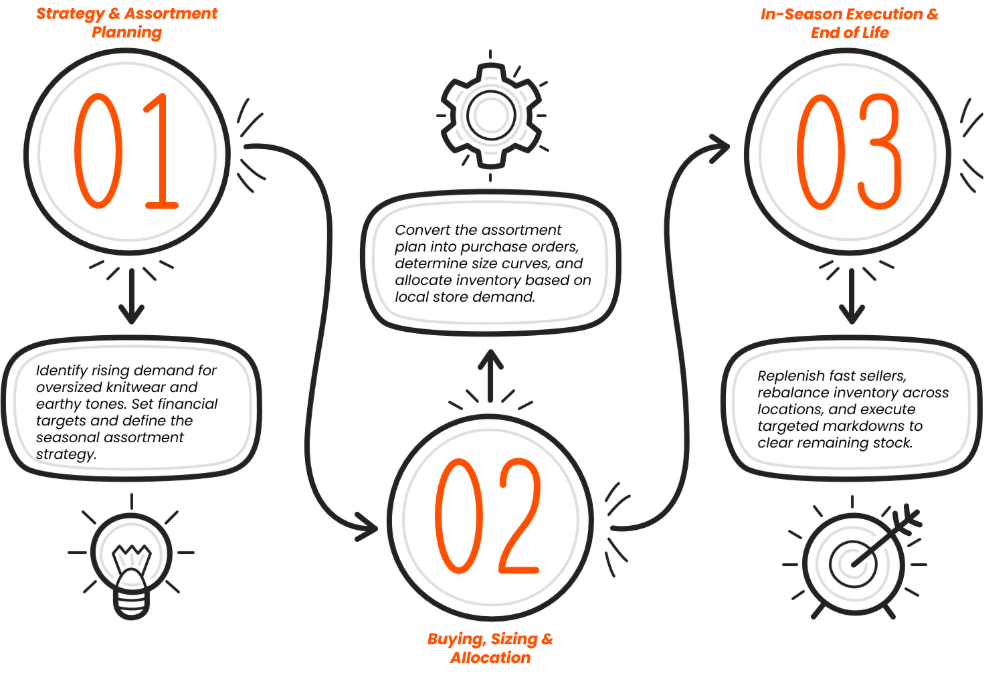
Act I: Strategy & Assortment Planning (The Vision)
This is the conceptual stage where the season is born. Financial planners and creative buyers collaborate to set high-level financial targets, identify macro-trends, and define seasonal color palettes. They build the initial assortment architecture, deciding how much budget to allocate to stable "basics" versus high-risk, fashion-forward pieces.
Act II: Buying, Sizing & Allocation (The Commitment)
In this stage, the strategic vision is translated into tangible commitments. Assortment plans are converted into purchase orders (POs). In fashion, this phase is uniquely complex because it requires defining precise size curves. Retailers must predict not just that a sweater will sell, but how many Small, Medium, and Large sizes are needed. Finally, planners must allocate these styles across different store tiers and geographic climates, ensuring heavy coats go to colder regions and resort wear heads to warmer locales.
Act III: In-Season Execution & End of Life (The Chase)
Once the product hits the floor, the "live-action" phase begins. Merchandisers must actively monitor performance, chasing inventory for unexpected viral bestsellers and managing the flow of products from distribution centres to storefronts. As the season nears its end, they must execute targeted markdown strategies to clear out slow-moving items and minimize terminal inventory (leftover stock that ultimately ends up in landfills or discount bins).
Despite the structured nature of the merchandising process, the reality of execution is often fraught with friction. Industry reports consistently highlight that overstock and stockouts remain two of the most expensive problems in fashion retail. These issues stem from deep-seated cracks in traditional planning foundations.
1. The Disconnect Between Creative and Financials
In many retail organizations, a "broken handshake" exists between the fashion buyers—who focus on trends, aesthetics, and brand identity—and the financial planners—who are strictly focused on margins, inventory turn, and budgets. Because these teams often operate in silos using disparate, disconnected spreadsheet models, the final purchase orders rarely reflect the initial strategic vision. This leads to beautiful assortments that completely miss financial targets, or overly conservative buys that fail to excite the modern shopper.
2. The Fog of a Volatile, Trend-Driven Market
Historical data is a poor predictor of future fashion trends. A traditional planning system looks at what sold last year to determine what to buy this year. But historical models cannot account for sudden macroeconomic shifts squeezing discretionary spending, anomalous weather patterns delaying the sale of winter coats, or a viral influencer video causing a niche accessory to sell out overnight. Operating on outdated data leaves retailers reacting to the market rather than anticipating it.
3. The Hyper-Local and Sizing Puzzle
Fashion is incredibly personal and demographic dependent. A style that flies off the shelves at a trendy urban flagship store might sit untouched in a suburban mall. Furthermore, getting the size profile wrong at a local level is disastrous. Using a "one-size-fits-all" sizing strategy across a nationwide fleet guarantees massive stock-outs in popular sizes and markdown-inducing gluts in others. Static, rule-based legacy systems simply lack the granularity to capture these crucial local demand signals.
4. Blind Spots in a Fragmented Supply Chain
Fashion supply chains are notoriously complex and currently facing unprecedented disruptions. Fabric shortages, volatile global shipping times, and soaring e-commerce return rates create highly distorted inventory data. Merchandisers are often flying blind—unable to track exactly where their inventory is in real-time. Without accurate lead-time predictions, it becomes impossible to react quickly enough to save a short selling season.
The fashion industry can no longer afford the financial waste and missed opportunities born of disconnected, manual processes. So, what if merchandising could be transformed from a series of educated guesses into a single, intelligent, and self-correcting ecosystem?
Enter the era of the AI-orchestrated merchandising engine.
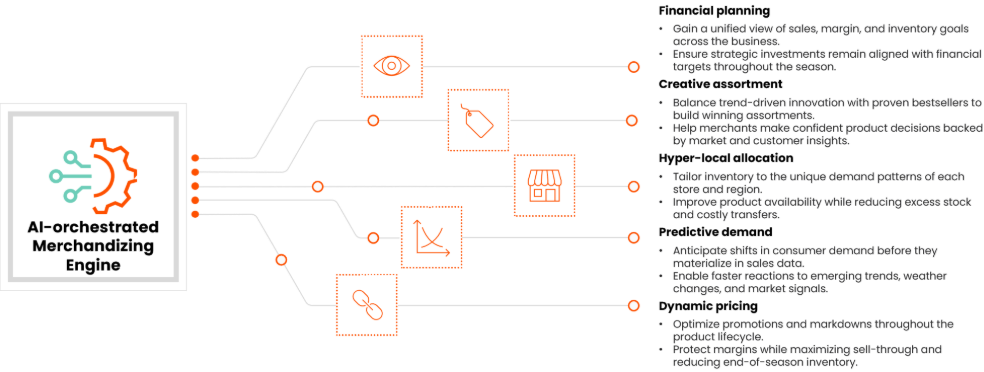
Rather than relying on human planners to manually reconcile hundreds of spreadsheets, forward-thinking retailers are beginning to look toward next-generation technology to orchestrate the entire lifecycle. This new approach shifts the paradigm across four key pillars:
- From Silos to Synergy: Imagine a platform that serves as a single source of truth, harmonizing the buyer’s creative vision with the planner’s financial goals in real-time. Every decision, from budget allocation to the final purchase order, is instantly reconciled, ensuring that artistic bets perfectly align with the bottom line.
- From Reactive to Predictive Demand Sensing: Picture a system that doesn't just look at past sales but actively ingests thousands of real-time external signals. By analyzing social media trends, local weather forecasts, and competitor pricing movements, AI can help brands anticipate demand with high accuracy, allowing planners to pivot inventory before a trend cools off.
- Mastering the Size Curve & Localization: Envision intelligent agents that understand the unique demographic and sizing DNA of every single store in a fleet. These systems can automatically tailor assortments and size runs to hyper-local demand, virtually eliminating the dreaded "broken size run" and drastically reducing regional overstock.
- Intelligent Lifecycle Automation: Think of a system where routine decisions are automated. AI agents can continuously monitor in-season performance to autonomously recommend inventory shifts and highly targeted markdowns. This maximizes margins before the season transitions and frees up human planners to focus on what they do best: high-value strategic thinking and creative direction.
Outfitting the Future of Retail
The high-stakes world of fashion merchandising will always require the human touch—the eye for design, the understanding of culture, and the bold creative bets that define a brand. However, the operational backbone supporting those creative decisions must evolve.
The future of fashion retail will not be won by those who simply manage inventory, but by those who can intelligently master it. The era of agentic, AI-driven merchandising is arriving, offering a definitive path to reduce waste, increase agility, and ensure that the right trend always finds the right customer.

