The Data Exploration Bottleneck
Data scientists spend weeks manually exploring massive datasets, writing exploratory SQL, and producing repetitive notebooks just to hypothesize which signals might improve model performance.
With T-Discovery - Tredence's Agentic Feature Discovery Accelerator, replace weeks of manual data exploration with intelligent agents that automatically discover, validate, and serve production-ready ML features.
The problem
Building real-time ML applications requires two distinct capabilities: knowing what features to build, and knowing how to serve them. Today, the first is the critical bottleneck. While modern cloud infrastructure has mastered real-time serving pipelines, identifying the data signals that actually drive high-performing models remains slow, manual, and human-dependent.
Data scientists spend weeks manually exploring massive datasets, writing exploratory SQL, and producing repetitive notebooks just to hypothesize which signals might improve model performance.
Because validation happens late and manually against business outcomes, competitive advantages are lost and projects stall before a single feature ever reaches production.
Databricks provides world-class serving primitives — Spark Real-Time Mode, Lakebase Online Feature Store, and Model Serving. These powerful systems sit completely idle until the right features are defined to flow through them.
The disconnect between manual data science exploration and production feature serving is where the majority of enterprise real-time ML projects stall.
Solution overview
T-Discovery is an agentic AI accelerator that bridges the gap between raw data and real-time production deployment. It introduces an autonomous intelligence layer called Milky Way that tells your native infrastructure exactly what features to serve, while Databricks' core engines handle how to serve them.
How it works
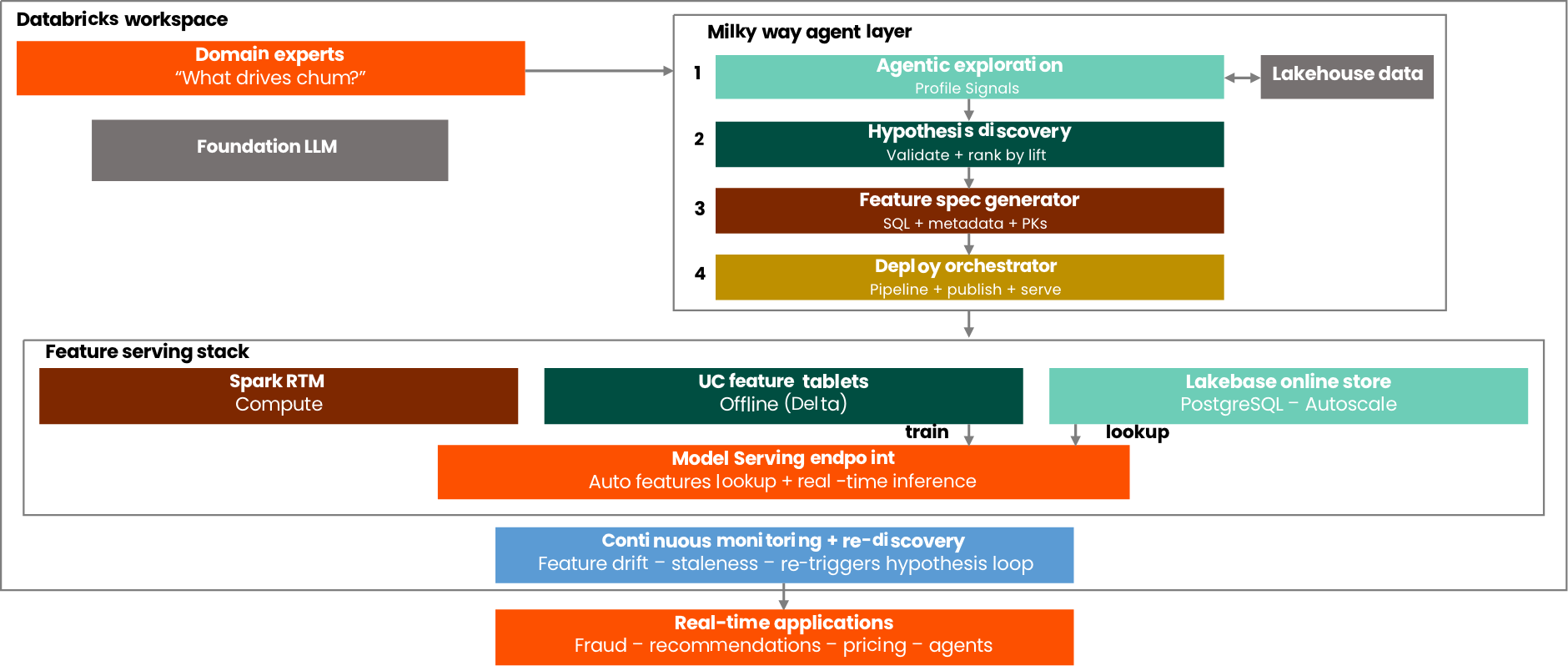
Domain experts describe business objectives in plain language — for example, "What drives customer churn?" The Milky Way agentic layer autonomously profiles signals and explores your lakehouse data to surface candidate features.
The engine automatically tests, scores, and ranks feature hypotheses against labeled historical outcomes, selecting only the candidates with verified mathematical lift.
T-Discovery auto-generates production-ready feature specifications, including optimized SQL pipelines, rich metadata, and primary and foreign key definitions.
The deploy orchestrator automatically publishes pipelines directly into Unity Catalog feature tables, Spark Real-Time Mode compute, and Lakebase online stores.
Solution capabilities
T-Discovery combines autonomous data reasoning with your existing Databricks ecosystem to eliminate manual pipeline development.
Replace weeks of manual notebook exploration with goal-driven agents that systematically mine lakehouse tables for hidden signals.
Instantly produce clean, enterprise-grade SQL, primary keys, and schema definitions tied directly to Unity Catalog metadata.
Deploy features directly to Spark Real-Time Mode, Unity Catalog feature tables, and Model Serving endpoints without manual configuration.
Automatically stream and surface optimized features through Lakebase, the managed, autoscaling PostgreSQL OLTP engine within Databricks.
Built-in loops monitor for feature drift and staleness, automatically re-triggering the hypothesis discovery phase to keep models accurate over time.
T-Discovery runs entirely within your own secure Databricks workspace, with no external dependencies and full data privacy.
Reference Architecture
T-Discovery's Milky Way agentic layer plugs into Unity Catalog, Spark Real-Time Mode, Lakebase, and Model Serving — generating and deploying the features your real-time engines were built to run.
Business & Performance Impact
Collapse feature engineering cycles from weeks of manual scripting to hours of automated agent execution.
Maintain strict data privacy compliance by running all agent exploration entirely within your native cloud security boundaries.
Unlock the full value of Databricks Lakebase and Spark Real-Time Mode by populating them with optimal data streams from day one.
FAQs
T-Discovery acts as an orchestration and intelligence layer that runs completely within your workspace. It doesn’t replace Databricks. It generates the code, schemas, and pipelines that feed directly into Unity Catalog, Spark Real-Time Mode, and Lakebase.
Lakebase is the high-performance online feature store layer. It is a managed PostgreSQL OLTP engine that handles auto-scaled, low-latency lookups for real-time inference applications.
Not at all. Domain experts and data scientists provide the initial business objectives and maintain full oversight. T-Discovery handles the heavy lifting of writing SQL, validating mathematical lift, and establishing primary keys, freeing data scientists to focus on strategy and model architecture.
Every enterprise sits on data signals it never operationalizes. See what's possible when intelligent agents discover, validate, and serve your features automatically — natively on Databricks.